Everly (2014)
Plot: hell hath no fury like a woman trapped, cornered, and scorned.
Have you also secretly pined for that Die Hard (1988) spin-off wherein a nubile Lucy McClane fights bad guys in her apartment? Everly answered the call and can charitably be summarized as, “Salma Hayek fights bad guys in her apartment wearing nothing but lingerie”. Everly is, as far as basic premises go, the contemporary equivalent of something that in the 1990s would have either Andy Sidaris, Albert Pyun, or Jim Wynorski written all over it. Not to put too much of a fine point on it, but this is an old-fashioned exploitation exercise in the guise of a modern mid-budget action movie. To the surprise of absolutely no one Everly looks just as terrible as it sounds. Not even Hayek’s generous (and frequently partly disrobed) form can redeem it. Albert Pyun might have quietly shuffled off this mortal coil but his spirit forever lives on. In other words, Everly is exhausted, exhausting, and not even half as witty as it thinks it is. A second coming of The Boondock Saints (1999) this most certainly is not. And, no, this is not that Everly Brothers biopic that nobody asked, or is waiting, for.
Everybody has to eat and not every A-lister has a surplus of high-profile projects lined up in between box office hits. Ever since her star-making appearances in Desperado (1995) and especially From Dusk Till Dawn (1996), high-profile auteur cinema as Traffic (2000) and Frida (2002), and Hollywood bilge as Once Upon a Time in Mexico (2003) and Bandidas (2006) Salma Hayek - at a ripe 48 and still the Méxican diosa she always and forever will be - still has to lower herself to mercenary gigs to put food on the table. Apparently past associations with Robert Rodriguez, Quentin Tarantino, Woody Allen, and Steven Soderbergh and being married to a French businessman/billionaire doesn’t mean Salma has the liberty (financial or otherwise) to choose when, where, and with whom she works. Everly was a Serbian-Japanese-American co-production on an estimated budget of $10 million originally meant for Kate Hudson. As much as we are a fan of Hayek it’s infuriating (not to mention degrading) that after twenty years of enduring the humiliations of Hollywood sensual Salma still has to waste her time on what is, for all intents and purposes, old school exploitation cinema. We’ll concede that la Hayek lends a degree of legitimacy that dreck like this clearly doesn’t deserve. Everly isn’t that far off Skyscraper (1996) (with the late pneumatically-enhanced Ana Nicole Smith) or Blast (1997) territory. Why does saucy Salma need to associate herself with the director of Wrong Turn 2: Dead End (2007)? Two decades in the Hollywood grinder and Hayek’s still a working actor forced to take roles as the common prostitute? The mind truly boggles at the grave injustice…

After being exposed as an FBI informant Everly (Salma Hayek) - a struggling single mother procured for (and coerced into) sexual slavery a decade earlier - has been brutally gangraped for her transgression and now finds herself locked into an opulent high-rise apartment by her sometime boyfriend (and Yakuza crimelord) Taiko (Hiroyuki Watanabe). He has threatened violence upon her young daughter Maisey (Aisha Ayamah) and her estranged mother Edith (Laura Cepeda) if she is not sufficiently compliant. She’s not a person, but a piece of Yakuza property and she has the irezumi (入れ墨) on her back to prove it, and is handled accordingly. Instead of killing her when he has/had the chance Taiko has envisioned a sadistic game wherein he unleashes wave upon wave of increasingly heavily-armed assailants upon her and the apartment. Bruised, battered, and beaten Everly has no intention of taking her impending demise lying down. From her gun-toting fellow prostitutes (whose motivations are purely selfish and driven by monetary incentives) to more professionally trained and military-armed mercenaries, black-suited assassins, as well as sadists (Togo Igawa) and masochists (Masashi Fujimoto). Everly is poised to give a whole new meaning to, “fuck with me ensues certain danger.”
Believe it or not, this was released the same year that John Wick (2014) revitalized the long-calcified American action movie and The Asylum released Mercenaries (2014) (with Nicole Bilderback). Compared to either of those this is one’s sort of modest (to the former) and decently funded (to the latter) in a Netflix sort of way. Not exactly expensive but not too expansive either. This is exactly the kind of swill that fills out streaming services queues. The domestic approach to Die Hard (1988) is certainly novel, but that’s about where the good things end too. Everly tries it darndest to have a heart and a soul but effortlessly fails at humanizing any of its characters. Whether Salma is a prestigious oiran (花魁) or the far more common yūjo (遊女) is, sadly, never revealed. The apartment is a decent enough killbox but it’s never as claustrophobic and intense as BuyBust (2016) or as visually arresting as Maria (2019). Neither is it as impressively action choreographed as Furie (2019). America continues to hopelessly lag behind whereas Hong Kong perfected the Girls with Guns formula 40 years ago with Yes, Madam! (1985) (Michelle Yeoh in her first starring role) and the three-part Iron Angels (1987-1989) saga. Salma Hayek is a lot of things but Moon Lee Choi-Fung (李賽鳳) she’s not. While no warmblooded male is going to reasonably complain about la Hayek traipsing around barefoot in skimpy lingerie and sometimes a nightie, and not much else – but Salma’s plump bare ass, sadly, by itself, is not nearly enough to sustain or hinge an entire premise on. And premise is really all that Everly has. There’s no real plot, let alone an actual story. Comparisons to Go Ohara’s story-free splatterfest Geisha VS Ninjas 芸者VS忍者 (2008) are inevitable and expected at this point.
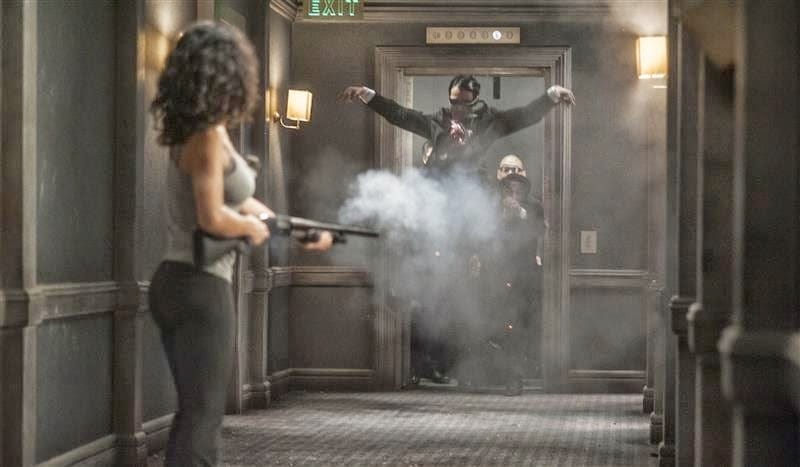
Instead of committing to the innate sleaze and grimy filth that a semi-grindhouse throwback title like this so richly deserves Lynch does the honorable, respectable Hollywood thing and not expose la Hayek and her legendary curves absent a gander of her bare back. In fact Lynch is so much of a prude that that long expected steamy shower scene unfortunately never materializes. It’s entirely possible that Salma is opposed to doing nudity (she did her fair share in the second half of the 1990s) and that certainly is her perogative, but that is what body doubles are for. There’s a running gag of Everly constantly putting on and kicking off her shoes (usually the most impractical) whenever a new wave of assailants engulfs the apartment. Another gag of sorts is that Everly continuously is able to either ward of (or outright kill) her assailants through sheer dumb situational luck. She never professes to have any firearms training and is never portrayed as such. Still, it remains pretty funny through out. Given Lynch’s penchant for horror the blood flows quite freely in Everly. No matter how turgid and slickly rote it is, it’s leagues more professionally filmed than the median René Perez action romp – and that should count for something, anything. Salma is as breathy and husky as she always is, and it’s time somebody finally gives her that high-octane action movie she so earnestly deserves. Suffice to say, this is, and was not, it.
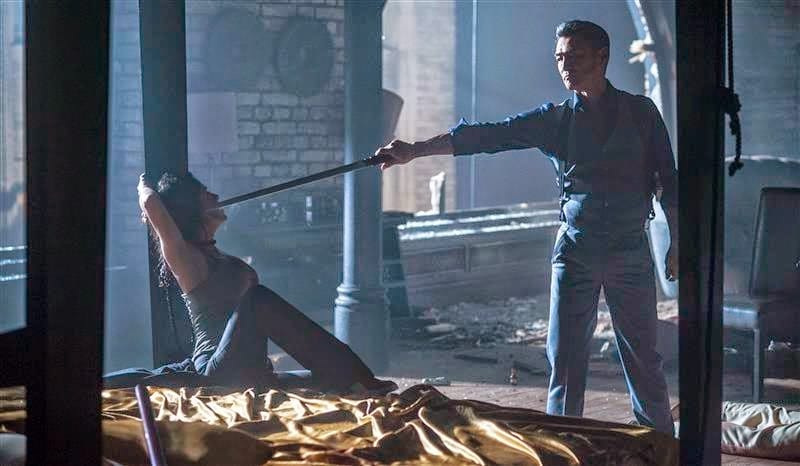
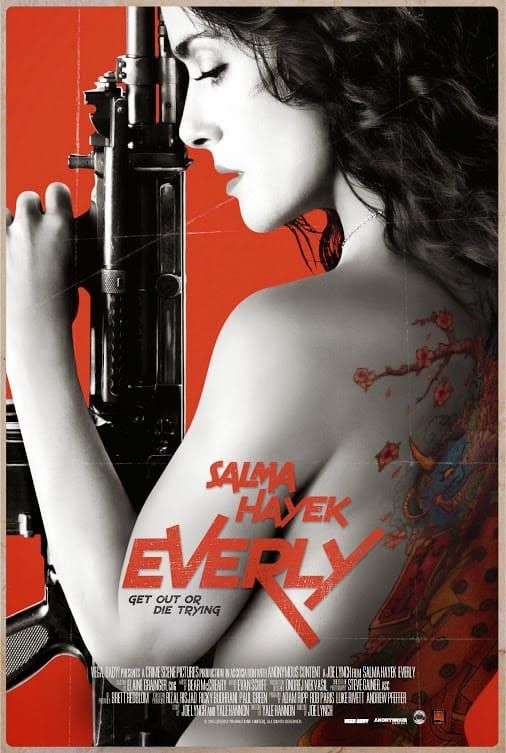
Lynch himself has ever so eloquently described this as, “Die Hard with boobs” but with the singular focus not on Salma and the things that make her bounce and jiggle this is the exact opposite of grindhouse evergreens as Ginger (1971), TNT Jackson (1974), or Naked Fist (1981) and the 1970-1974 period of the Christina Lindberg filmography. Some have described this as an allegory about female empowerment but with the central character both a prostitute and a struggling single mother it’s hard to take seriously. As an action movie it’s kind of flat with terminally dull pacing and a distinct lack of climax, payoffs, or jiggling boobs to keep the viewer interested. All in all, there are a dozen or so deaths – each exceedingly absurd, bloody, and violent than the last. All of that would amount to something, anything if we got to see Salma’s Everly grow or improve her lot in life in some way. There are explosions, sure, but nothing in Everly elicits true fireworks. The promotional art tries very hard to sell this as some Naked Killer (1992) adjacent boobs-and-bullets fest, but unfortunately none of that transpires. The tedium isn’t evened out by la Hayek gradually struggling for garments to keep covered up. To its credit, at least it was conceived as a stand-alone feature. Byzantium (2013) cost 2 million dollar less, had more expansive locales (not to mention a period drama segment), recognizable talent, and looked a thousand times more expensive. Every hard-earned dollar is clearly not on the screen. The Die Hard (1988) template has lost none of its inherent potency but good imitations are still very few and far between. Testament to that are contemporary female-centric rip-offs as Interceptor (2022), Exterritorial (2025), Cleaner (2025), G20 (2025), or Bride Hard (2025) that are beset by many an issue, none necessarily related to their politics or lead stars. Regardless, none of them have fared any better. In the decade since there, thankfully, hasn’t been a sequel.