Nocturna (1979)
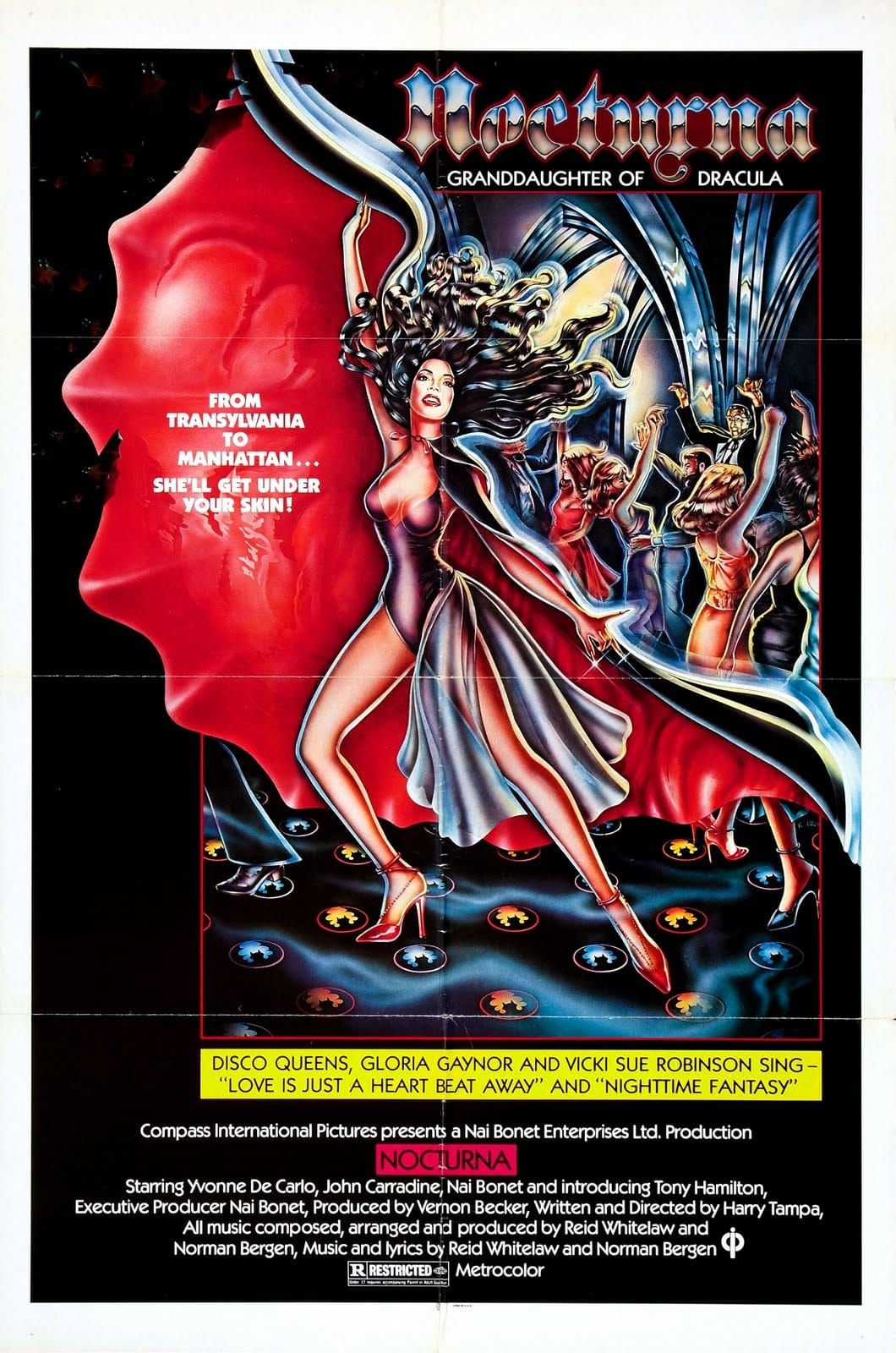
Plot: dance the night away at Disco Transylvania in Transylvania.
At the peak of disco in the late seventies Michael Jackson, Donna Summer, Sister Sledge, the Bee Gees, and ABBA all had chart-topping albums. Saturday Night Fever (1977) brought disco culture to the masses, and Van Nuys Blvd. (1979), and Skatetown, U.S.A. (1979) were quick to capitalize on the trend. Studio 54 was the Mecca, and Chic, Luv’, and Kool & the Gang filled dancefloors everywhere. Even hard rock band Kiss was swayed into doing a disco album with 1979’s “Dynasty”. In Italy former beauty pageant Gloria Guida caterwauled her way through Night Nurse (1979), while in Germany Summer Night Fever (1978), Popcorn and Ice Cream (1978), and Cola, Candy, Chocolate (1979) rode the disco wave and had Olivia Pascal, Ursula Buchfellner, and Christine Zierl in tiny bikinis (and frequently less) shaking their rump. In Italy Luigi Cozzi unleashed his candy-colored masterpiece StarCrash (1978), where David Hasselhoff wore more hair gel and make-up than Caroline Munro. Meanwhile, back in the old US of A, somebody was brewing on a concept that would change everything. A gothic horror vampire flick - rife with sleaze and nudity – for the disco age produced by Irwin Yablans, the man behind Halloween (1978), Tourist Trap (1979), and the disco comedy Roller Boogie (1979). That movie was Nocturna, Granddaughter Of Dracula (simply Nocturna hereafter, for brevity and sanity’s sake) and featured an all-star cast of familiar faces, and a platform to launch up-and-coming New York disco sensation Moment Of Truth. Had Nai Bonet found a way to incorporate rollerblading into it it would’ve been the penultimate disco age time-capsule. Uh, who’s Nai Bonet, you wonder? The writer, producer, and general devil-do-all who dreamed it all up.
The creative force behind Nocturna was Las Vegas, Nevada-based belly dancer Nai Bonet (née Christine Shapazian in Sài Gòn or Ho Chi Minh City, Vietnam on January 6, 1939). If you never even heard of Bonet, that’s completely understandable. Back in the Golden Age of exploitation Italy had Cuban import Bella Cortez, and for the past several years Europe has been blessed with curly, curvy, and thick Ukrainian goddess Diana Bastet. Back in the day America had Nai Bonet. Bonet debuted in 1958, at tender age of 13, as a showgirl at the Flamingo Hotel in Las Vegas. In 1966 Nai experienced moderate success with the novelty single 'Jelly Belly' – co-penned by Earl Wilson, Jr., whose father frequently covered Bonet in his 6-day a week column "It Happened Last Night" in the New York Post as an entertainment writer and gossip journalist – for Scopitone video jukeboxes. The same year Nai modeled on the cover of “Turkish Delight - 51 Belly Dancer Favorites” from Gus Vali And His Orchestra, and then again in 1973 for his “Belly Dancer Favorites”. From there Bonet was able to parlay her good looks into bit roles as exotic dancers, all of which culminated in smaller – and decorative roles in grindhouse favorites Devil's Angels (1967), The Soul of Nigger Charley (1973), Soul Hustler (1973) and Fairy Tales (1978). That last one would prove every bit as fateful as it allowed Nail to forge an alliance with director Harry Hurwitz. Over the years Bonet had been collecting story ideas for her grand feature debut. At long last all the pieces seemed to be falling in place. Now, it seemed, was as good a time as any….
And thus Bonet did what any genuine artiste would do. She formed her own production company, Nai Bonet Enterprises, Ltd. – and embarked on the arduous quest of securing funding for her vanity project. Nai was able to raise $350,000, one part of which was put up by Vernon P. Becker, the director of Dagmar's Hot Pants, Inc. (1971) and producer of Joe Sarno's Every Afternoon (1972), and the other half allegedly by construction mogul William Henry Callahan. Callahan is most remembered for his role as Harold Crandall in the comedy Chicken Every Sunday (1949). He was a regular on Broadway and on TV variety shows. Bill left show business in 1952 and married business heiress Eleanor Rao. He started working in his millionaire father-in-law’s electrical concern Arc Construction where he rose to top corporate positions of executive vice president and treasurer. At its peak Arc Construction employed some 600 people. At some point his son William, Jr. discovered his father was embezzling millions in company funds to finance his lavish debonair jet set lifestyle – and William, Sr. soon found himself in hot water. Like any good crook Bill and his mistress Wendy McDade (21 years his junior), a chorus line dancer at the Rainbow Grill in Rockefeller Center and as part of the Pearl Lang Dance Company, disappeared into the sunset. First to Chicago and then to the West Indies and only returned to the Big Apple to be tried in court. Callahan was alleged to have Mafia ties and on March 18, 1981 both he and 29-year-old McDade were found shot to death, execution style (three bullets to the head from a .25 Beretta) near the Chiwaukee Prairie nature preserve in Lake Michigan in Kenosha, Wisconsin. Nai did what any star would do and spent $100,000 on securing the hottest disco tunes. Somehow Bonet was able to convince Irwin Yablans to come aboard, and he invested an additional $200,000 on the promise of exclusive distribution rights for his Compass International Pictures. In October and November 1978 cameras rolled in and around New York and soon Nocturna was in the can.
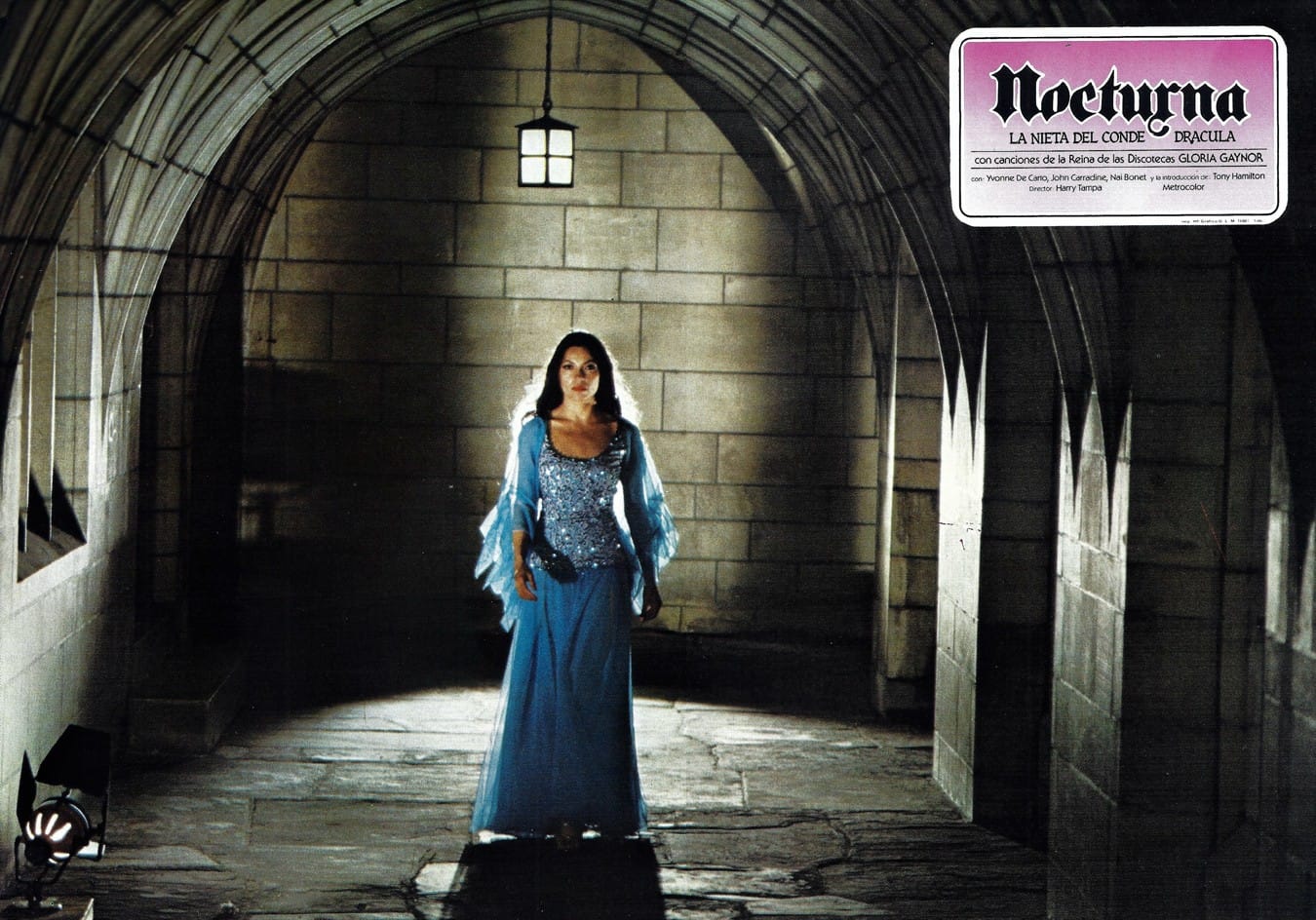
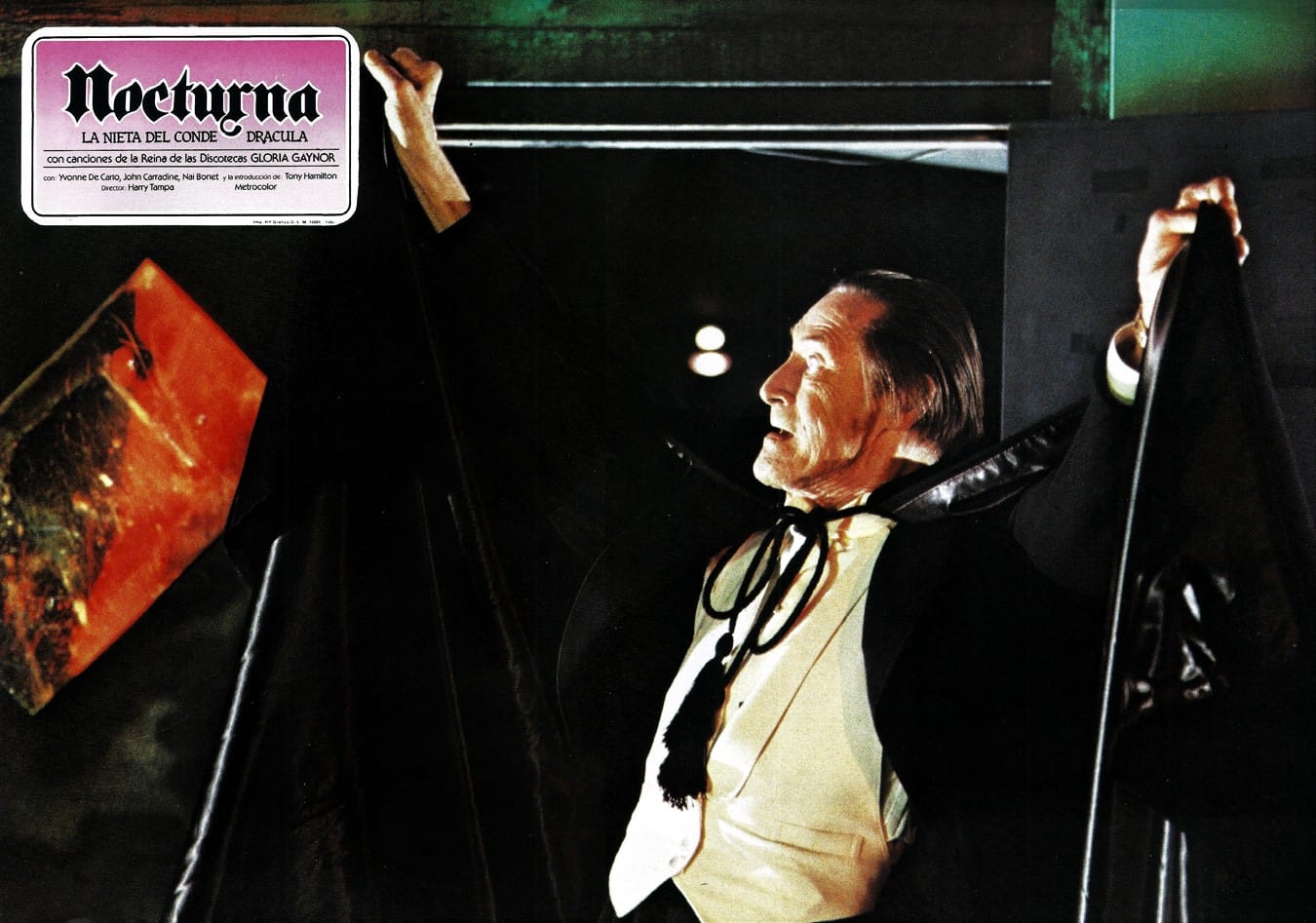
Transylvania, 1979. Count Dracula (John Carradine) finds himself in financial dire straits and on the brink of ruin. To pay for overdue taxes the old Count has opted to convert his castle into a hotel. He has left the day-to-day operations of running the resort to his 126-year-old granddaughter Nocturna (Nai Bonet) who he also has left in charge of booking entertainment for the establishment. This particular evening up-and-coming New York disco sensations Moment Of Truth are slated to audition for a multi-night engagement at The Claret Room. Almost as soon as she lays eyes upon him Nocturna is smitten with guitarist Jimmy (Antony Hamilton) and she soon starts to question her immortality. A brief and steamy courtship ensues, and before long Nocturna and Jimmy run off to New York. The count orders Theodore (Theodore Gottlieb, as Brother Theodore), a lycanthrope with an unhealthy interest in his employer’s granddaughter, to intercept and return Nocturna to her ancestral home in Transylvania. Meanwhile, Nocturna connects with her grandfather’s old flame Jugulia Vein (Yvonne De Carlo) and they embark on a wondrous journey through the underbelly of the Big Apple. In short order Nocturna and the gang encounter black pimp RH Factor (Sy Richardson) who moonlights as a dealer of designer-blood and runs a brothel out of his massage parlor The Tricky Hickey, and they attend a meeting of the BSA (Blood Suckers of America), a vampire rights activism group holding debates on the future of the species and their integration/acceptance into mainstream society. In the dance temple Starship: Discovery 1 Jimmy is tempted by Brenda (Monica Tidwell) for a dance, but he’s waiting for Nocturna. Things come to a head when Dracula confronts Nocturna in the dance hall and she convinces her grandfather of the merits of humanity, and of mortal love, by engaging in an extensive dance routine.
Except that there was one crucial element that withheld Nocturna from becoming the bona fide cinematic classic Bonet it probably was envisioned as, and that was historically bad timing. In 1979 the gothic horror revival ship had long sailed. The genre was dead. Just like the Italian giallo it was to be made instantly redundant by the first wave of American slashers following John Carpenter’s masterclass in fright Halloween (1978) and the surge of Mediterranean European zombie gutmunchers following the success of George A. Romero’s Dawn Of the Dead (1978). The subtle nuances and atmospherics of gothic horror were lost on an audience that craved cheap thrills and bloodier kills. None of which Nocturna had. Nocturna found itself on that awkward middle ground between a bawdy sex comedy, a satire, and a horror spoof. What it lacked in gore and grue it made up in sleaze and nudity. Nocturna was scion of Italian kitsch as The Vampire and the Ballerina (1960) and The Playgirls and the Vampire (1960) and signaled the end of a decade-long horror spoof cycle that began with Roman Polanski’s The Fearless Vampire Killers (1967). Other notables including The Vampire Happening (1971), The Horrible Sexy Vampire (1971), Old Dracula (1974), Lady Dracula (1977), Vampire Hookers (1978), and Love At First Bite (1979). Nocturna is not as restrained as The Slaughter Of the Vampires (1962). Nor is it as unabashedly erotic as The Velvet Vampire (1971), or Vampyres (1974). Gothic horror was on the verge of extinction. This was the year Andrea Bianchi gave the world Malabimba (1979), which pretty much killed the genre for the better part of a decade.
In true Edward D. Wood, Jr. fashion Nai had surrounded herself with a motley crew of beloved Golden Age of Hollywood superstars in their twilight, models, and musicians. Most prominently among them John Carradine, Yvonne De Carlo, and Theodore Gottlieb. Carradine – father of Robert, Keith, and David – was a regular in Shakespearean theatre and John Ford westerns. In the forties he could be seen in The Grapes of Wrath (1940) as well as horror pulp as House of Frankenstein (1944), and House of Dracula (1945). In the mid of the following decade he was in big studio productions as Around the World in 80 Days (1956), but from the sixties onward his star faded and he became a fixture in exploitation, action, and horror. As such he can be seen slumming it up in Madame Death (1969), Silent Night, Bloody Night (1972), Terror in the Wax Museum (1973), Superchick (1973), Mary, Mary, Bloody Mary (1975), The Boogeyman (1980), and The Howling (1981). The only ray of light in Carradine’s twilight years was Don Bluth’s The Secret of NIMH (1982). In 1979 Carradine was in poor health and truly decrepit-looking; ravaged not only by an advanced stage of rheumatoid arthritis – but also the wear and tear of old age.
Yvonne De Carlo was a famous Hollywood star in the forties and fifties. She’s most remembered for her bit part in For Whom the Bell Tolls (1943) from Paramount Pictures and for Warner Bros’ Band of Angels (1957) (alongside Clark Gable) and the peplum The Sword and the Cross (1958). The television series The Munsters (1964–1966) signaled her best days were behind her and from mid-seventies onward De Carlo's career spiraled steadily and irrevocably downwards. By 1979 she was slumming it up in various smaller productions. Her character is called Jugulia Vein. How’s that for humor? And what do Carradine and De Carlo have in common, you wonder? They both were in Cecil B. DeMille’s biblical epic The Ten Commandments (1956) and in the goofy sex comedy Satan’s Cheerleaders (1977) just two years before.
Theodore Gottlieb was an eccentric German-born American actor and comedian better known as Brother Theodore and inventor of stand-up tragedy. Gottlieb survived Dachau concentration camp and the Holocaust by fleeing to England as a chess master with the help of Albert Einstein. Once in America he became a nightclub performer and picked up acting. He could be seen in The Stranger (1946), So Dark the Night (1946), and The Third Man (1949). Gottlieb became a regular a guest on The Tonight Show Starring Johnny Carson, The Dick Cavett Show, The Joey Bishop Show, as well as The Merv Griffin Show, and in the 1980s on Late Night with David Letterman. Gottlieb suffered from severe depression and paranoia and was a prolific voice-actor working for television, animation, commercials, and film trailers. He’s most remembered around these parts for narrating the North Americans trailers for Mad Doctor of Blood Island (1968) and Lucio Fulci’s House By the Cemetery (1981).
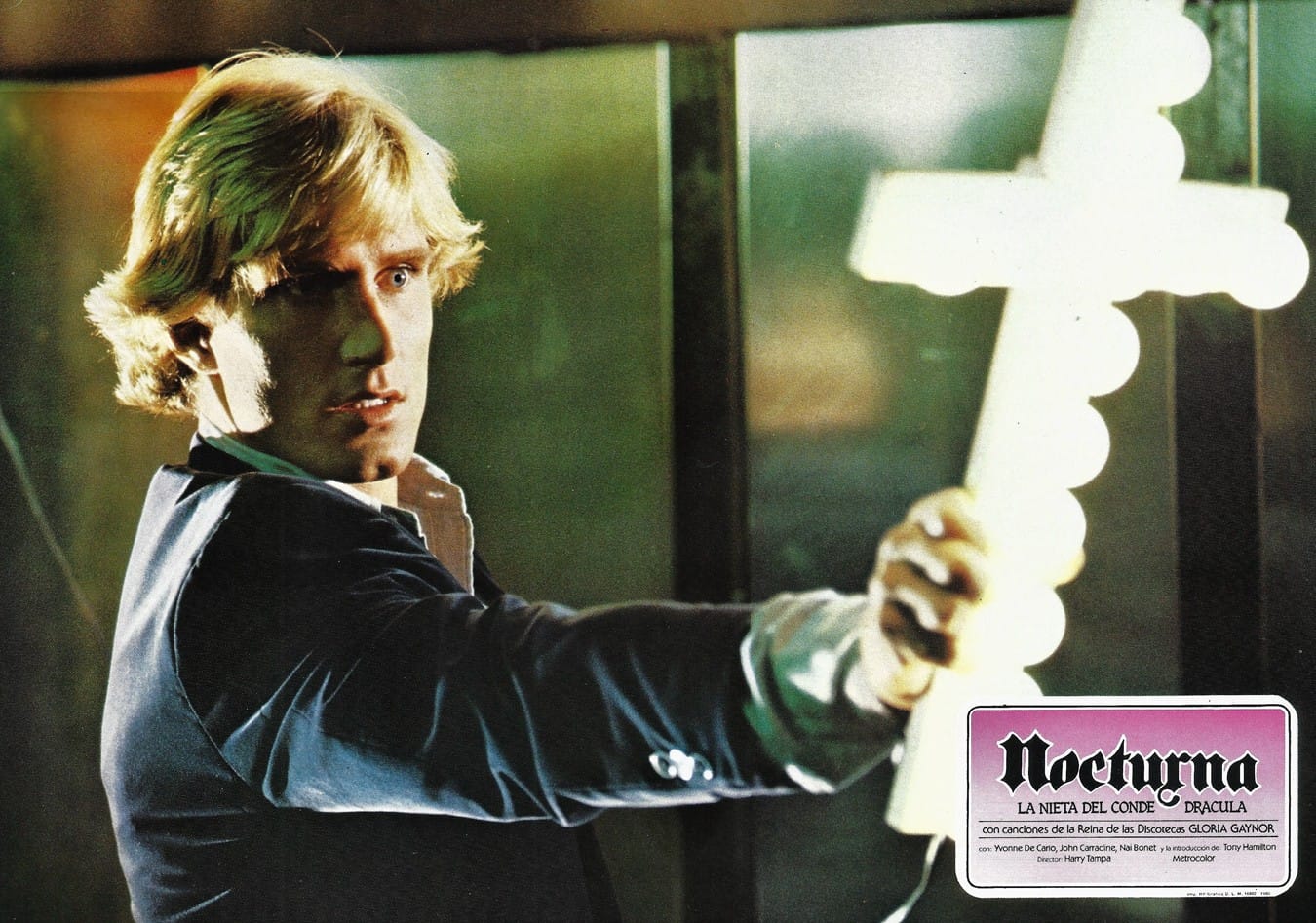
As for the newcomers, they are former ballet dancer and model Antony Hamilton, sometime Playmate Monica Tidwell, dancing queen Vicki Sue Robinson, and disco upstarts Moment Of Truth. In the eighties Hamilton could be seen in the Sheena Easton music video for ‘Swear’ and was poised to become the next James Bond in The Living Daylights (1987). Except that Hamilton was blond and openly gay leading Albert R. “Cubby” Broccoli to cast Timothy Dalton when Pierce Brosnan was contractually tied to Remington Steele (1982-1987). Hamilton would persevere in television up until his death from complications from AIDS in March 1995. The other nominal star was Monica Tidwell, Playmate of the Month (November, 1973) and veteran of The Yum Yum Girls (1976) and The Astrologer (1975). Vicki Sue Robinson was successful in her own right. She too was a regular on Broadway and had her own disco smash hit with the Grammy-nominated 'Turn the Beat Around' in 1976 (revived commercially for the second time in 1994 by Gloria Estefan). She sang commercial jingles for Gillette, General Motors, Maybelline, Sprite, Downey Fabric Softener, Doublemint Gum, and Folgers Coffee; sessioned for Cher, Michael Bolton, Cyndi Lauper, and RuPaul; and sang backing vocals on Irene Cara's 1980 perennial evergreen 'Fame'. Moment Of Truth was a vehicle for producers Norman Bergen and Reid Whitelaw, and soon split after the release on Nocturna. Bonet brought on Gloria Gaynor for the song ‘Love is Just a Heartbeat Away’ alongside the songs Robinson had contributed. Gaynor reluctantly agreed to sing as a favor to her manager and soon-to-be husband Linwood Simon.
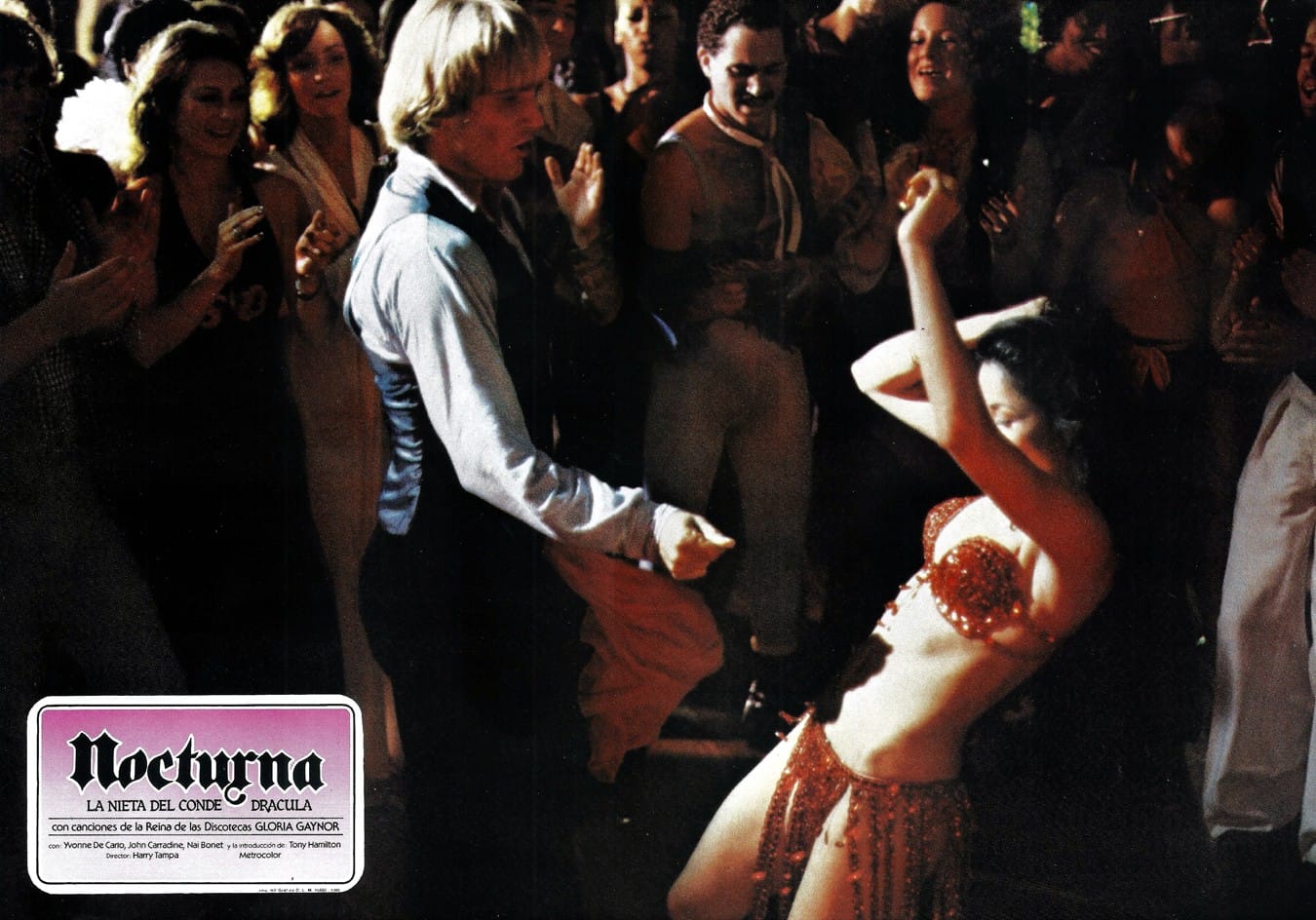
Nocturna premiered at the 8th Paris Festival of Fantastic Films (a precursor to today’s Paris International Fantastic Film Festival, or PIFFF) in France on March 1, 1979 where it was presented alongside such illustrious curios as Dominique, Supersonic Man, The Day Time Ended, and Don't Go in the House and others. Whereas some of its immediate competition have attained greater or smaller cinematic immortality, Nocturna almost instantly sank into obscurity. While not as artsy (or erratically edited) as, say, Black Magic Rites (1973) or the equally stream-of-consciousness Nude For Satan (1974) Nai Bonet’s vanity project crashed and burned just as hard. Unfortunately, Bonet never quite became the American Rita Calderoni (or Stefania Fassio, or Christa Barrymore for that matter) Nocturna had primed her as. Instead Nai wrote, produced, and starred in Hoodlums (1980) (substituting Hurwitz for director of photography Mac Ahlberg) before falling off the face of the Earth. Not a lot is known about Bonet since 1980…
What little has been heard in the four decades since is that a digital restoration and remaster of Nocturna seems unlikely. Nai opposes any kind of release on grounds of the excessive nudity involving herself and her female co-stars. Which is unfortunate because this is the sort of little-seen oddity that would do well among cult fanatics. Unlike how Lipps Inc.’s ‘Funkytown’ concluded the disco era with a giant earworm of a song and double-whammy of Gary Numan with his synth-pop evergreen ‘Cars’ on the one side and the trifecta of Dire Straits, The Knack, and Eric Clapton with ‘Sultans Of Swing’, ‘My Sharona’, and ‘Wonderful Tonight’, respectively, on the other ensured its summarily execution with the emerging punk rock movement providing the proverbial funeral rite and eulogy. These days Nocturna is all but forgotten and nothing but a well-deserved footnote in exploitation – and disco history. That it was released a month before Disco Demolition Night at Comiskey Park in Chicago, Illinois on July 12, 1979 (that ended in a riot) probably didn’t help either. Nai Bonet and Nocturna put disco in a coffin, drove a stake through its heart, and never looked back. At least a few metal bands in Italy, Lebanon, Spain, and Colombia keep the name out there…