Sister Death (2023)
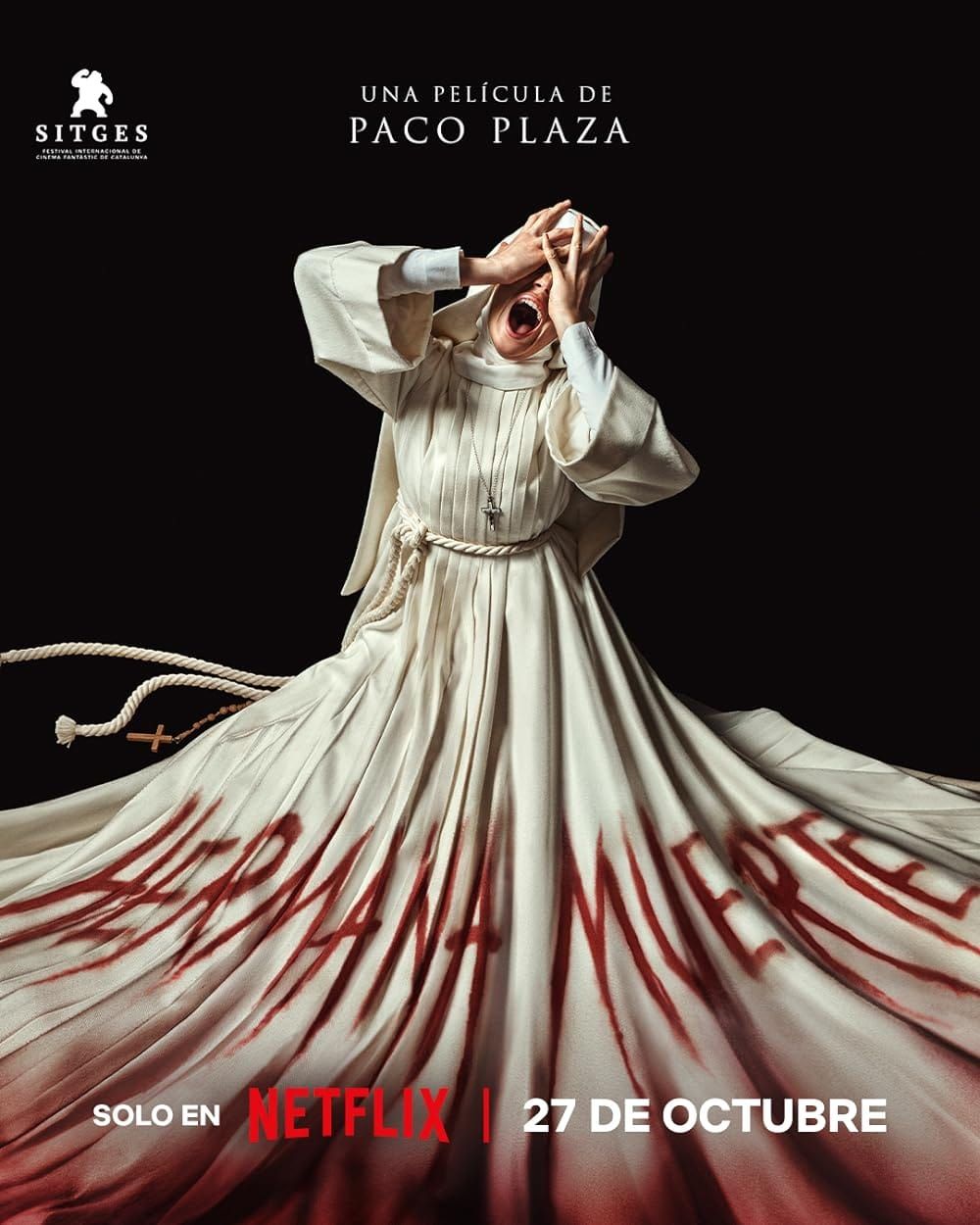
Plot: novice nun has a brush with supernatural horrors… and lives!
Hermana Muerte (or Sister Death) is the long-awaited (but something we honestly quietly forgotten about) prequel to Spanish surprise horror hit Verónica (2017) and apparently an attempt to turn it into a universe of sorts. To its credit Sister Death explores the backstory of Hermana Muerte and taking the focus away from young Verónica allows it to expand upon the existing story within a different horror subgenre. While the subgenre might be different Sister Death very much adheres to the Verónica (2017) template, and Paco Plaza is never shy about referencing his surprise streaming hit. For whatever reason Verónica (2017) has become something of a minor modern day classic and is often described as, “the scariest movie ever!” both by people who should know better and by those that don’t. Regardless of from whence it came Sister Death does most things right while establishing a clear identity of its own.
Since her breakthroug role in Verónica (2017) Sandra Escacena has mostly done television work and the occasional theatrical feature. Paco on the other hand has continued to work steadily in the horror genre by directing an episode on the series Stories to Stay Awake (2021) and things as The Grandmother (2022). Understandably, now with the pandemic behind us, Plaza and Escacena returned to what made them famous before the world (at least temporarily) ended. Whereas Verónica (2017) was written by Fernando Navarro here the screenplay was from the hand of Jorge Guerricaechevarría. And it shows. Guerricaechevarría has been the trusty writing partner of Álex de la Iglesia for several decades now and he has regularly written for Daniel Monzón. He writes for other directors too. Most notably he wrote Live Flesh (1997) for Pedro Almodóvar. As far as we're aware this is the first time writing for Plaza. We never heard of Aria Bedmar prior and neither of Almudena Amor for that matter. Amor has been with Paco since The Grandmother (2022). Thankfully both Sandra Escacena and Consuelo Trujillo return in cameos in their respective roles. While Verónica herself was an amiable protagonist it was always hermana Narcisa that spoke to the imagination. Unfortunately Ángela Fabián (who was a bit thicker and curlier than your average in 2017 – and apparently has not acted in anything since) is nowhere to be seen. Sister Death at long last explores the origin story and events that led to how Narcisa became the preternaturally wise soothsayer of the beloved original.
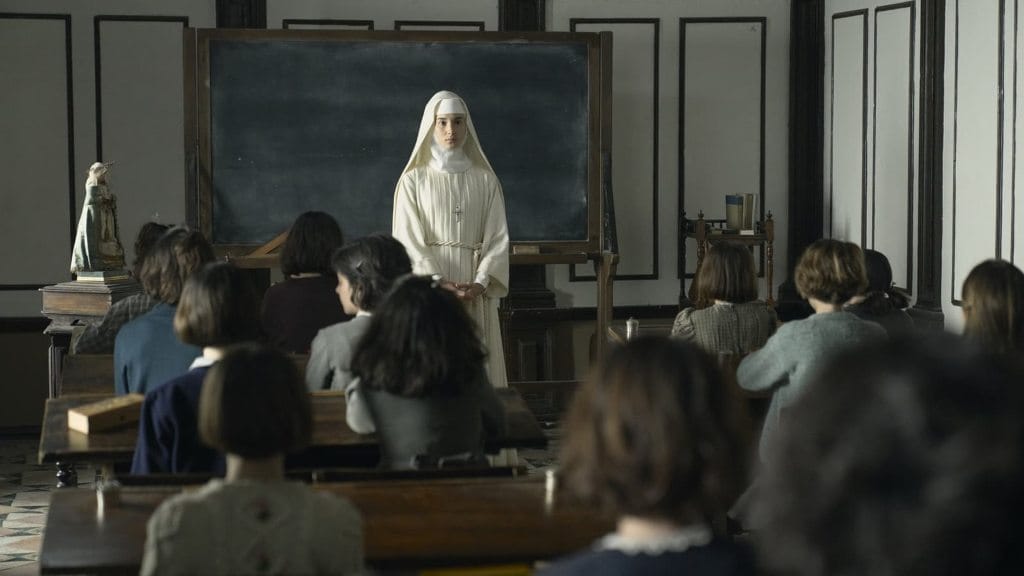
At the end of the Spanish Civil War (1936-1939) young Narcisa (Ainoa Hernández) is revered by the simple and superstitious townsfolk of Peroblasco in Munilla (in the province of La Rioja) for alleging to have received holy visions. During her youth she was paraded around as a child preacher famous for quoting scripture and performing the occasional miracle. Ten years later, in 1949, Narcisa (Aria Bedmar) has lived as a postulant and just received her admission into the novitiate. She’s welcomed by administrator Sister Julia (Maru Valdivielso) and later she receives instructions from Mother Superior (Luisa Merelas) that she’ll be teaching Spanish, literature, and natural sciences. In her cell Narcisa finds a cigar box with letters, scissors, and a funerary photograph of Sister Socorro (Almudena Amor) stowed away mysteriously. Meanwhile, in class, sisters Rosa and Elvira (Sara and Olimpia Roch) are spooked by the sudden appearance of an incomplete hangman drawing and the curse of “the girl.” Whenever Narcisa inquires after the fate of Sister Socorro she’s met with obstinate silence. What terrible secret have the nuns kept buried within the convent walls for so long? 42 years after her brush with the supernatural, in 1991, the now grizzled Hermana Muerte is ordered to teach the class of 15-year-old adolescent Verónica (Sandra Escacena).
While we feared that this would be another feeble (and instantly forgettable) The Conjuring (2013) retread; unbelievable as it may sound Sister Death actually does an honest to Odin effort to revive a long since extinct subgenre, the ecclesiastical horror. It’s most gripping scenes and poignant moments are more Italian than Spanish while its treatment of Roman Catholicism is distinctly Mexican in its contempt and disdain for organised religion, and Catholicism at large. The monochrome prologue recalls The Demon (1964). Sister Narcisa’s passion into secular illumination more or less follows the same contours as Sister Maria’s in Satánico Pandemonium (1975). She bleeds from the eyes just like Catriona MacColl in City Of the Living Dead (1983) and she too experiences hallucinations involving the spirits of the dead on gallows. At one point Narcisa vomits chunks violently and towards the end another nun projectile vomits blood but it never reaches the kind of excess and abuse Lucio Fulci inflicted upon poor Daniela Doria. Sadly, neither is there an equivalent to Antonella Interlenghi, circa 1979 or 1983. Regardless, this is all about Aria Bedmar but to our personal liking there’s far too little Verónica (or Sandra Escacena rather) and no Ángela Fabián whatsoever.
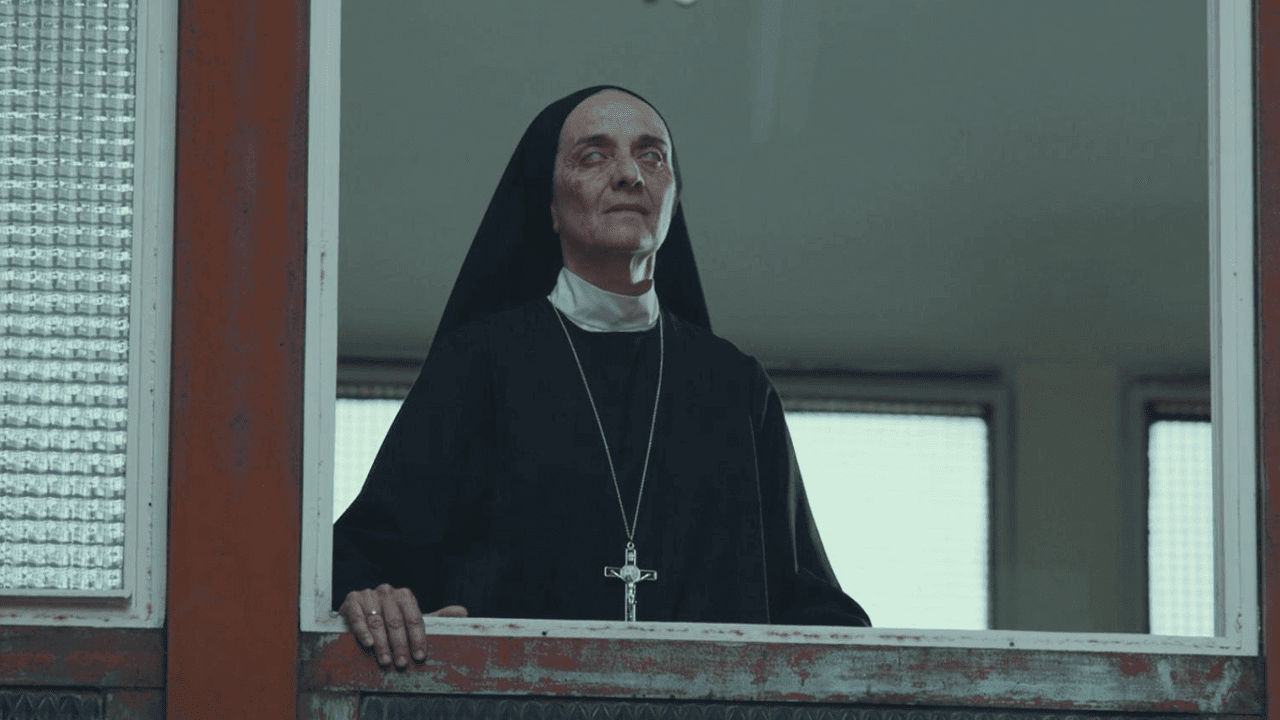
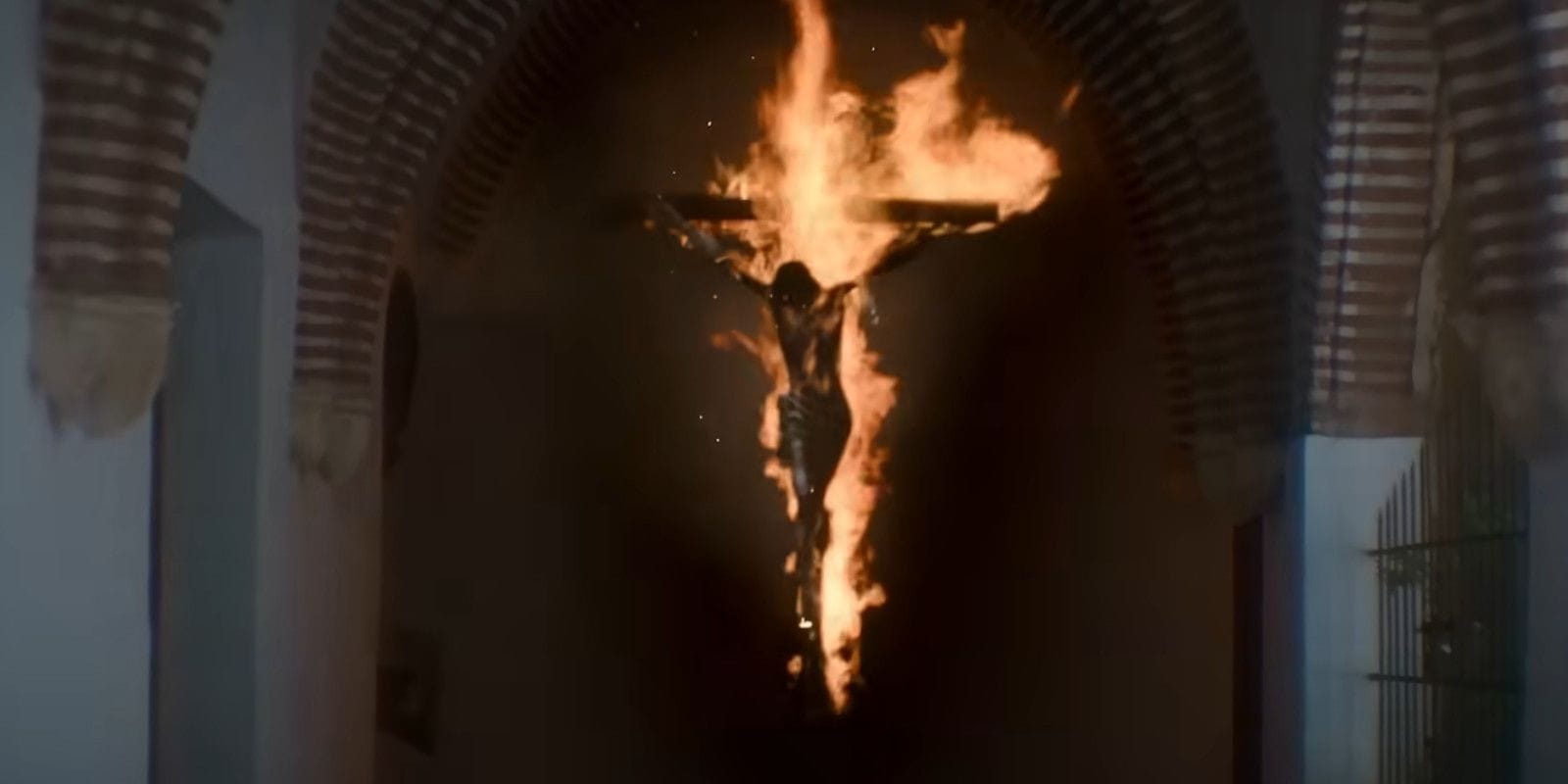
The nuns are made to look like moribund hags that rejoice in self-flagellation and seem more concerned with doctrine, liturgy, and orthodoxy than with the community service of education they supposedly provide. Their corruption reeks of Convent Of Sinners (1986) and their downfall is self-inflicted in the tradition of Flavia the Heretic (1974). Contempt for creatures of habit and the delusion of the religiously impaired can be traced back to The Phantom Of the Convent (1934) and Don't Deliver Us from Evil (1971), to name but two. In Paco and Jorge Guerricaechevarría’s vision the convent (the Monastery of Sant Jeroni de Cotalba in Valencia) and its murky darkened interiors more resemble a tomb or a medieval dungeon rather than a hall of worship. Imagine if Paco had used the ruins of the Monastery of Santa Maria la Real de Valdeiglesias (these days simply known as the Monastery of Pelayos) in Madrid for the exteriors instead. Paco dares not put the nuns in burial gowns, something which Alucarda (1977) already did half a century ago, anyway. One death was lifted wholesale from The Day of the Beast (1995) (that Guerricaechevarría also wrote, the man’s free to plagiarize his own writings). The reliance on jumpscares (telegraphed and otherwise), usage of deep and long shadows, as well as the obligatory animation and levitation of inanimate objects (usually chairs and doors) screams contemporary ghost horror in the worst ways and at the center is the plot device from Ring (1998). Any movie that partakes in the profanation and desecration of religious symbols and climaxes with the immolation of a crucifix straight out of Enter the Devil (1974) gets a plus in our book. Suffice to say, the blasphemy and heresy is much welcomed. The plot hinging upon a solar eclipse was completely unnecessary but, sadly, a rule that Verónica (2017) established.
Verónica (2017) was better than it had any right to be but Sister Death is that rare follow-up (prequel, sequel, or otherwise) that effortlessly eclipses the original by looking further back for inspiration. Whereas Verónica (2017) was a simple but effective contemporary ghost horror Sister Death looks and feels much older. This harkens back to the nunsploitation and diabolism movies that were part and parcel in the 1970s in the wake of The Devils (1971) and The Exorcist (1973) and relaxation of censorship laws. By expanding upon the backstory of the secondary character (and nominal villain) and by cleverly chosing a different horror subgenre Sister Death meets expectations by telling roughly the same story in a different setting and time period and doing enough of its own thing to warrant said exploration in the first place. This is to Verónica (2017) as what Furies (2022) was to Furie (2019) in that it deepens the existing universe by expanding upon the mythology of the quasi-antagonist without forgetting what made the original work so compelling. Hopefully Pablo Paco will soon give Ángela Fabián her own feature or cast both her and Sandra Escacena in another of his horror productions. We’ll take this over the latest Norberto Ramos del Val or César del Álamo any day of the week.