The House Of Pop (1989)
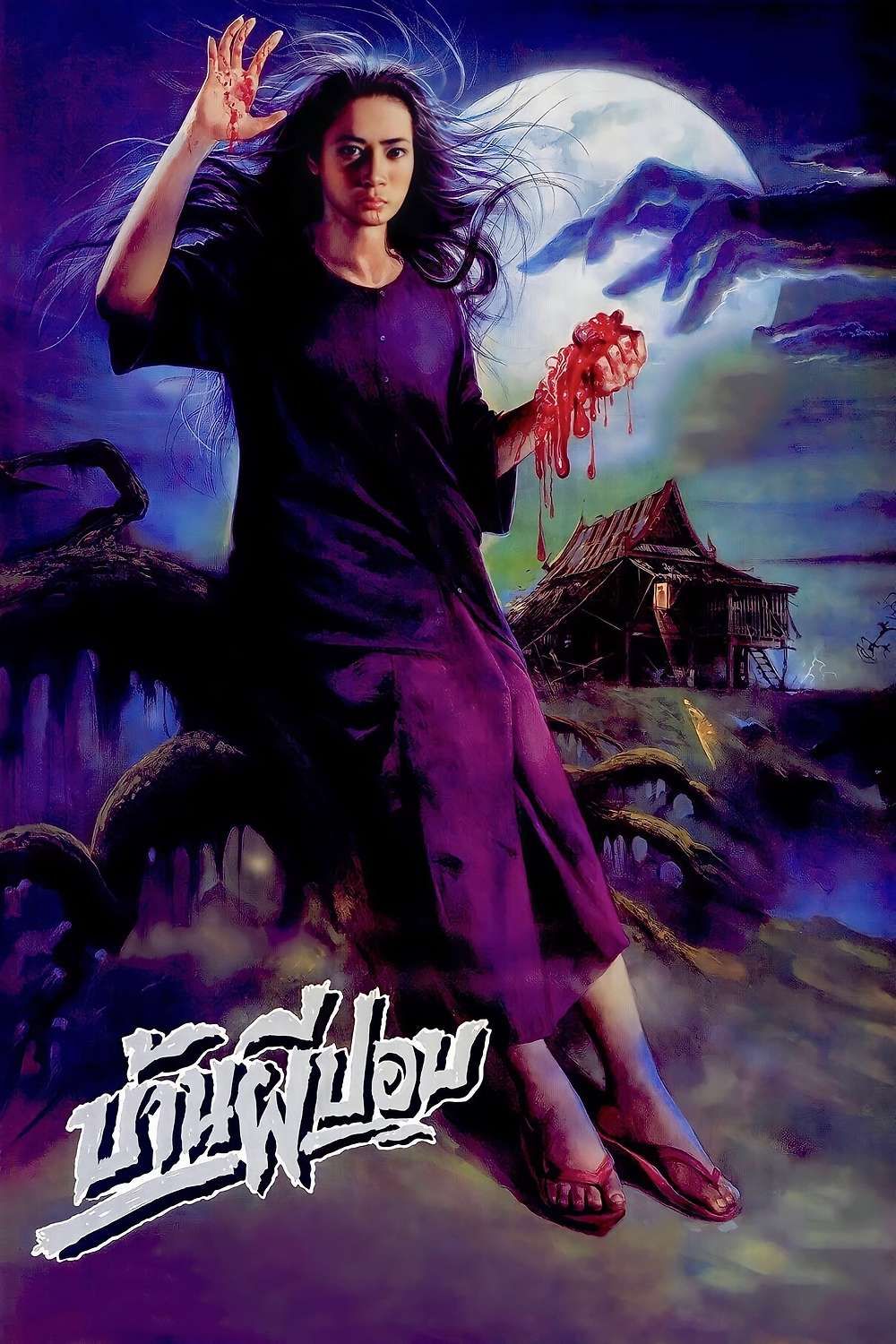
Plot: sleepy rice-farming village is haunted by a carnivorous ghost.
บ้านผีปอบ (or Ghost House, Haunted House, or The House Of Pop in some international translations, all of which roughly convey the same) is the first part in Thailand’s longest running horror franchise and truly humble in its ramshackle beginnings. Unbelievable as it may seem The House Of Pop somehow was able to become a cultural juggernaut, the first big Thai horror franchise that continues to persist to this day and refuses to go quietly into that good night. Like its monster this franchise seems impossible to kill and modern remakes and reboots have only made the past entries that much legendary. What better way to get into Thai horror than with one of its most famous monsters? It may not have pierced the Western consciousness the way Suzzanna and her sundel bolong from Indonesia has but it is at least half as legendary – or should be, at any rate.
There’s a certain mystique about Southeast Asia, their rich folklore, and how their approach to horror differs from the West. The Philippines, Hong Kong, the isolationist and protectionist China, Indonesia, and far less prominent, the nearby Taiwan, and Singapore all have transcended their national borders and pierced the West to varying degrees. That there’s a degree of overlap between Indonesia, Thailand, and Malaysia shouldn’t come as a surprise given the geographic proximity of the islands, and the shared (or largely similar) cultural/religious customs and folklore. Thailand, like the similar Malaysia, remains largely untrodden territory, nigh on inpenetrable, and mostly undiscovered for us. Outside of a few selected action movies from Chalong Pakdeevijit and more recent offerings like the coming of age ghost horror of P (2005) and Inhuman Kiss (2019) there isn’t too much we’re familiar with.
The bestiary of Thai folklore is incredibly vast and diverse with hundreds of ghosts and ghouls of various stripe, origin, and occassion. In the interest of brevity and the purview of this review there’s about three mythological entities who have made it to the West, whether by accident or cultural osmosis. First, and relevant here, is the innard-eating Phi Pop (ผีปอบ) ghost of Lao-Isan folklore or the Northeastern part of the country. These ghosts can take residence in either humans or animals. In films of this kind they usually appear in form of an elderly lady or a desirable young woman. Second, there’s the krasue (กระสือ) that’s slightly lesser known but instantly recognizable regardless. This nocturnal spirit is in the form of a flying disembodied head with the spinal cord, intestines and other internal organs dangling underneath. Third, there’s Mae Nak Phra Khanong (แม่นากพระโขนง or Lady Nak of Phra Khanong), or the ghost of a woman who died during childbirth and now haunts people (typically the husband), and can extend her arms to unnatural length. This, at long last, brings us back to The House Of Pop which squarely focuses on the gut-devouring Phi Pop ghost.
Who was the man behind The House Of Pop? Saiyon Srisawat (ศรีสวัสดิ์), or the Thai variant to the Ramsay dynasty of Indian horror at large. Srisawat was a specialist who catered to the discerning tastes of the uneducated, the religious, and the illiterate in remote and distant backwater villages. This was horror for the contemporary age that appealed to (and preyed upon) age-old fears and petty provincial prejudices unique to rural audiences, young and old. Like Indian horror in the prior decade Thailand no longer modeled itself after the old Universal Horror (and the its European imitators) and Val Lewton movies of the 1930s/40s wherein white sari clad ghosts frightened pious townsfolk. This thing was, and is, completely unassuming and there were no great expectations for it from anybody.
It was filmed quick and dirty on 16mm with no sound (all of which was dubbed in post-production) in a week in the rice farming village Suphan Buri along the Tha Chin River on an estimated budget of 400,000 baht (or the equivalent of roughly 12,000 U.S. dollars) with local cast and a skeleton crew. It was a multi-starrer (or an ensemble cast for the West) with frequent on-screen couple Treerak Rakkandee and Ekkapun Bunluerit, screen veteran Nuttanee Sittisamarn (who soon would become the franchise’s central figurehead and henceforth be known as The Queen of Pob Yib), and Suchada Eam. The biggest name here is probably rom-com heatthrob and horror pillar Thongchai Prasongsanti. Prasongsanti starred in the 1993 and 1995 sequels to the robot girlfriend rom com Somsri #422 R. (1992) alongside Chintara Sukapatana. The biggest difference between the original and the sequels was that it was conceived as a straight-up ghost horror (with the occassional semi-comedic bit to brighten the mood). Like the more familiar jungle war movies these ghost horrors all tend to look and sound the same. You can almost feel the oppressive heat and crushing humidity from the jungle emanating from the screen.
When disemboweled bodies are found on the outskirts of town rumors of a ghost devouring the undesirable spread quickly. With no clear description or specifics surrounding the killings the first, and most obvious, suspect is grandma Yip (Nuttanee Sittisamarn) who the more religiously impaired element of the townsfolk accuse of black magic and witchcraft. In actuality the ghost has taken up residence in the frail and aged body of grandma Thongkham (Suchada Eam) who’s in the habit of scaring everyone with her stern demeanor. Grandma Yip on the other hand has the unfortunate tendency to embark on inexplicable nocturnal walks that strike fear in the heart of everybody within earshot. The village chief (Samart Payakaroon) and his clumsy, bumbling assistant Chuchuan (Thongchai Prasongsanti) have taken to assuring the townsfolk that there’s no reason to panic and that everything has a rational explanation. God-fearing and virtuous farm girl Plap Pleung (Treerak Rakkandee) looks after the needs of Yay Yip and ensures that she gets home safely every night. One day a group of volunteer doctors deployed from the capital city of Bangkok under guidance of Dr. Khun Ret (Ekapan Banleurit) come to administer medical care to the needy locals. Meanwhile, the village chief’s nubile daughter Kradeung (Sararat Rumruangwong) causes consternation among the male populace of the village as traipses around town in her sarongs and bathes in the streams and lakes with her friends. As the bodies contineu to pile up Plap Pleung and Dr. Khun Ret believe that a Phi Pop (ผีปอบ) is at work. The villagers by sheer dumb luck deduct that the only way to ward off the nocturnal predatory hauntings is to hide in a ceramic jar filled with water. Armed with this knowledge the doctor and the courageous village girl take to exorcising the Phi Pop by whatever means necessary to stop the brutal killings.
Let’s not mince words here. Thai horror, at least in case of The House Of Pop, bears some semblance to Turkey’s equally baffling Yeşilçam in its adherence to the tried-and-true principles and practices of pragmatism and improvisation. If there’s one thing playing in its advantage it’s that everything’s surprisingly well lit for the (non-existent) budget. Like its more popular Indonesian forebears the rudimentary and somewhat primitive special effects are charming in their home-made crudeness. Since this is, at least in part, somewhat of a comedy there’s the usual climbing in trees, people falling over and over each other, and all the usual slapstick shenanigans replete with sped up footage for maximum comedic effect. It’s not quite as odious as you might think and there are at least one or two genuinely chuckle-worthy moments. For those familiar (cursory or otherwise) with Indonesian horror of this decade Thailand too remains fairly conventional. Something like this does make Indonesian horror of this time look sophisticated. The shadow of Taiwan looms large over these productions as they too were often filmed in close proximity of each other with overlapping cast, crew, and locations under the auspices of a different director. Adding to the confusion and their obscurist nature was that there was little to no effort done to either chronicle or preserve any of these films or the information about them for posterity.
The Philippines had Amalia Fuentes, Indonesia had Suzzanna, Malaysia had Maria Menado, and Thailand had (at least for a short while) Treerak Rakkandee and Nuttanee Sittisamarn. Her lead role as Nak in the television series Mae Nak Phra Khanong (1989) (that also co-starred Ekapan Banleurit as the husband) prepared Treerak Rakkandee for her near five-year tenure (1989-1993) as the reigning horror queen of the day as she rose to fame playing the phi pop ghost and other villain ghost roles in a string of either straight up ghost horrors or light-hearted spoofs thereof. She starred in the first three The House Of Pop movies as well as several mini-franchises with similar plots and ghosts. Of the dozen movies she starred in seven focus on the Phi Pob ghost. Among these Holocaust of the Ogre Clan (1990), Filth Eating Spirit Bites Ogre (1990), and Family Tree Ghoul (1990) are probably the most famous.
Rakkandee bowed out The House Of Pop after part 3 but later landed a supporting part in Evil Black Magic (1992), a crazy Hong Kong fantasy horror from invocator of the insane, Ho Meng-Hua (何夢華) or he of The Mighty Peking Man (1977), The Oily Maniac (1976), Black Magic (1975), and The Flying Guillotine (1975). Rakkandee later reinvented herself as a singer. Absent Rakkandee, Sittisamarn became the reluctant de facto figurehead in The House Of Pop 4 through 13 (there’s no part 12 as far we could find), the 2008 remake, and the 2011 reboot. All three of the leading men Ekkapun Bunluerit, Samart Payakaroon, and Thongchai Prasongsanti were able to parlay their roles here into long careers on the big and the small screen. Bunluerit and Payakaroon remain active to this day and Prasongsanti was last seen working pre-COVID-19 pandemic.
The House Of Pop was, perhaps expectedly, not an instant box office hit in the more cosmopolitan Bangkok but the rural Northeastern audiences ate it all up. Clearly these very same audiences in the rural, highly superstitious, lowly educated provinces of the country wanted more and Saiyon Srisawat was happy to deliver. In between 1989 and 2011 there were at least 12 official sequels along with a slew of ripoffs, cash-ins, and imitations. For maximum confusion there was also the competing (and highly similar) Ghost Species พันธุ์ผีปอบ franchise which offered the more of the same, just with a more comedic bend – and the usual cash-ins and imitations. Even without subtitles someone familiar with the conventions of the ghost horror subgenre should be able to navigate this. As always, subtitles are preferred but dubbed English versions (if they exist) should roughly convey largely the same thing. The House Of Pop does nothing you haven’t really seen before but does it very much in its unique folkloric way. This one sets up the gimmick of having two ghosts that pervaded through the first sequel. Besides, in late 1980s tradition the scuzziest trash has the greatest poster art.