Cave Of the Living Dead (1964)
Plot: Balkan village is haunted by strange disappearances and power outages.
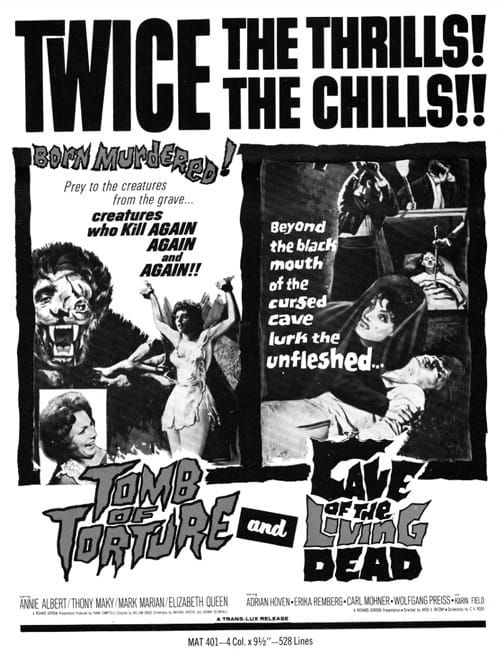
Der Fluch der grünen Augen (or Curse of the Green Eyes, für diejenigen, die kein Deutsch sprechen - released in the English-speaking world as Cave Of the Living Dead) is a minor entry in the canon of German krimi and gothic horror. This Yugoslavian co-production is a beautifully photographed, if not exactly riveting, exercise in gothic horror more famous for who was in front and behind the camera than anything else. History has remembered it as not exactly a milestone, or in any way, essential. Regardless of its place and relative unimportance in German horror history that doesn’t change that Cave Of the Living Dead is surprisingly effective (if a little underwhelming) when its more ambitious artistic proclivities are allowed to freely flourish. In 1966 it was re-released in North American grindhouses on a double bill with the equally visually flat and entirely pitiful Italian gothic horror Tomb Of Torture (1963).
Ráthonyi wrote and directed a dozen films in Hungary from 1936-41, then made two movies in Italy in 1942, and finally he spent the last twenty years of his career (1949 to 1968) in West Germany, or the Federal Republic of Germany (FRG, Bundesrepublik Deutschland) as it was then called. Before his foray into comedy he produced and directed this neat little gothic. Apparently he was a prominent and acclaimed director in the homeland but we cannot claim to have seen any of his Hungarian films. Leading are Adrian Hoven, Karin Field, Wolfgang Preiss, Carl Möhner, and Erika Remberg. Hoven was an established actor and two years away from directing The Murderer with the Silk Scarf (1966) and figuring into Jesús Franco’s psychotronic era with Succubus (1968), as well as Two Undercover Angels (1969), and its sequel Kiss Me Monster (1969). He would star in Mark of the Devil (1970) and direct its sequel Mark of the Devil Part II (1973) as well as The Long Swift Sword of Siegfried (1971). Field had starred in the early Ernst Hofbauer sex comedy The Fountain of Love (1966) and via the wholesome Heimatfilme crooner musical Heintje - A Heart Goes on a Journey (1969) ended up at the wrong end of a butcher’s knife in The Mad Butcher of Vienna (1971). Just four years prior Preiss had starred in the equally atmospheric Italian gothic horror Mill of the Stone Women (1960) as well as being Dr. Mabuse in Fritz Lang's The 1,000 Eyes of Dr. Mabuse (1960), as well as the sequels The Return of Dr. Mabuse (1961), The Invisible Dr. Mabuse (1962), The Terror of Dr. Mabuse (1962), and finally as a spectral apparition in Dr. Mabuse vs. Scotland Yard (1963). He would build a considerable resumé playing Nazi colonels, generals, and field marshalls in World War II epics as The Longest Day (1962), Von Ryan's Express (1965), Anzio (1968), Raid on Rommel (1971), and A Bridge Too Far (1977). Möhner had been in the big budget Hollywood peplum The Fall of Rome (1963) as well as She Devils of the SS (1973). Remberg is mostly remembered for her brief yet steamy six-month love affair with Klaus Kinski during the filming of Sarajevo (1955) (history would repeat itself 30 years later with Italian minx Debora Caprioglio.) Rounding out the cast is John Kitzmiller from Dr. No (1962) who’s reduced to the caricature of the babbling superstitious black slave who constantly refers to himself in third person.
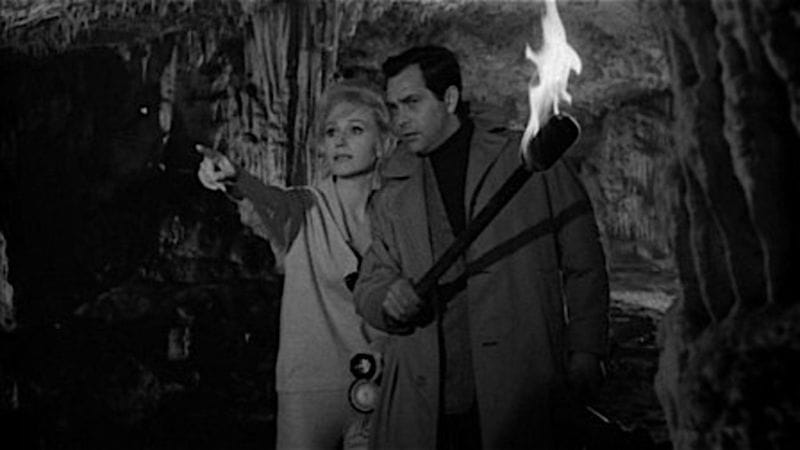
The local police of a secluded farming village in the Balkans is stumped by the disappearance and subsequent murder of six nubile women. Unable to crack the case they call for assistance from the German police. Der polizie contacts Interpol who dispatch a specialist. The commissioner (Danilo Turk) puts Inspector Frank Doren (Adrian Hoven) on the case informing him that each murder was preceded by a mysterious power outage. With little other information available to him Doren makes arrangements to travel to East-Europe under the guise of an American tourist and quietly commences his investigation. On his way to the inn he experiences inexplicable car trouble but he’s lucky to make his acquaintance with Karin Schumann (Karin Field), a member of the local scientific community. Schumann works as an assistant to Professor von Adelsberg (Wolfgang Preiss) who’s conducting a scientific research into blood from his hilltop castle on the outskirts of town. Once at the inn the superstitious elderly innkeeper (Laci Cigoj) imparts to Doren that he believes the disappearances are linked to the ominous shadows that lurk below the castle. The villagers have sternly warned him to steer clear of the castle as many have gone missing near its environs. When the inn’s young cook Maria (Erika Remberg) dies under mysterious circumstances and the village doctor (Carl Möhner) passes it off as a plain "heart failure" and the local gypsy witch (or fortune teller) (Vida Juvan) speaks of vampires living in the stalactite cave below the castle Doren is intrigued. Together with von Adelsberg’s servant John (John Kitzmiller) Doren and Karin explore the alleged cave of the living dead and the Curse of the Green Eyes that is supposedly holds.
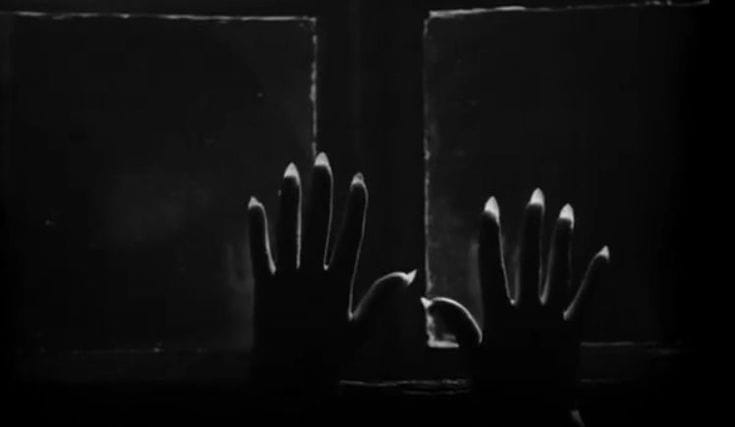
Like any decent gothic horror from this decade Cave Of the Living Dead is well-made but suffers from routinous, workmanlike direction bereft of any notable flair. It’s as creaky and extremely rustic as you’d want this sort of thing to be but it’s glacially paced even by forgiving 1960s standards. While the direction isn’t very inspired at least director of photography Hrvoje Šarić is allowed to line up one or two shots that are a bit artsy and sophisticated even though everything is surrounding it is kind of flat and uninteresting. Wolfgang Preiss brings a distinguished presence to his man of science but a threatening villain he most certainly is not. Preiss is gravely underutilized but his character dies by an impressive face-melting scene that must have impressed one or two people in Hollywood. Erika Remberg looks rather fetching and coquette and makes a stunning vampire bride. Karin Field is a fairly typical ice queen and largely redeemed by one scene where she strips down to black undergarments. For those who love that sort of thing in the original German when Doren inquires whether there’s something to eat upon his arrival at the inn the innkeeper says he has some “schinken” (or ham) left yet for some inexplicable (well, not inexplicable, probably sheer ignorance and simple phonetics) reason the English dub insists on calling it chicken. Trivial though it may be we good a good chuckle out of it regardless. Something like this could impossibly have worked in eye-searing and lush color and the monochrome photography actually enhances the thick charnel atmosphere. More importantly, though, is the gloomy location of Predjama Castle and Postojna Cave in the village Postojna in the historical region of Inner Carniola in south-central Slovenia. These were beloved tourist destinations back then and remain so to this day. If there’s anything even remotely unique to Cave Of the Living Dead then it’s this black castle and its gloomy caves.
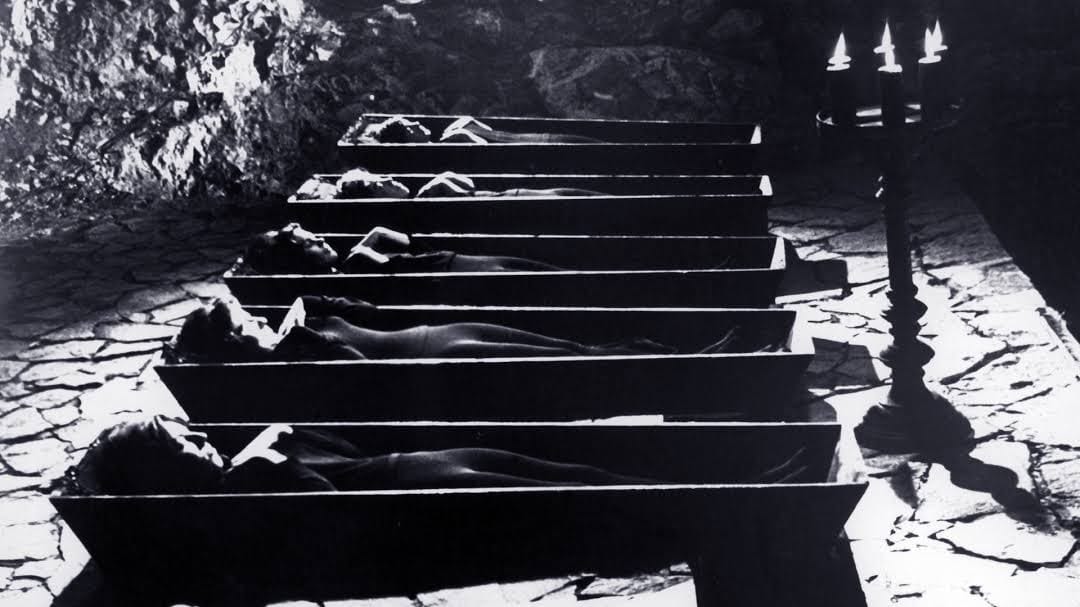
The only real novelty (or innovation) that Cave Of the Living Dead has to offer (if it can be considered that) it’s that it is set in then-contemporary times. Something which México already had done with The Vampire (1957) in the prior decade and what Emilio Vieyra would attempt three years later with Blood Of the Virgins (1967). Hammer was fashionably late to the idea and only tried it with grave misfire Dracula 1972 A.D. (1972) after the glamour years failed to lift them out of dire straits. Compared to Harald Reinl’s infinitely superior The Strangler of Blackmoor Castle (1963) this is but a minor entry and of no great importance. It never quite plunges the depth of poverty of, say, Tomb Of Torture (1963) and it’s even a step above the slightly sexier Crypt of the Vampire (1964). Its closest counterpart is probably The Blancheville Monster (1963) in its utilitarian proficience and grizzly grotto as well as México’s landmark The Vampire (1957) with its charming but not exactly imposing villain.
None of which diminishes anything from this one’s considerable own merits and creaky charm as a respectable and genuinely good exercise of the gothic horror genre. Even minors gems shine brightly when you are prepared to meet them halfway. As always, the original German version with subtitles is recommended over the dubbed international English-language version that was released in North America. Not that it suffers from knee-slappingly ridiculous dubbing choices but movies should always be experienced in their native language for full effect and immersion. Above and beyond anything else, though, Cave Of the Living Dead is ample evidence is that not all good gothic horror came exclusively from Britain’s aristocratic house of Hammer.