Fright (1971)
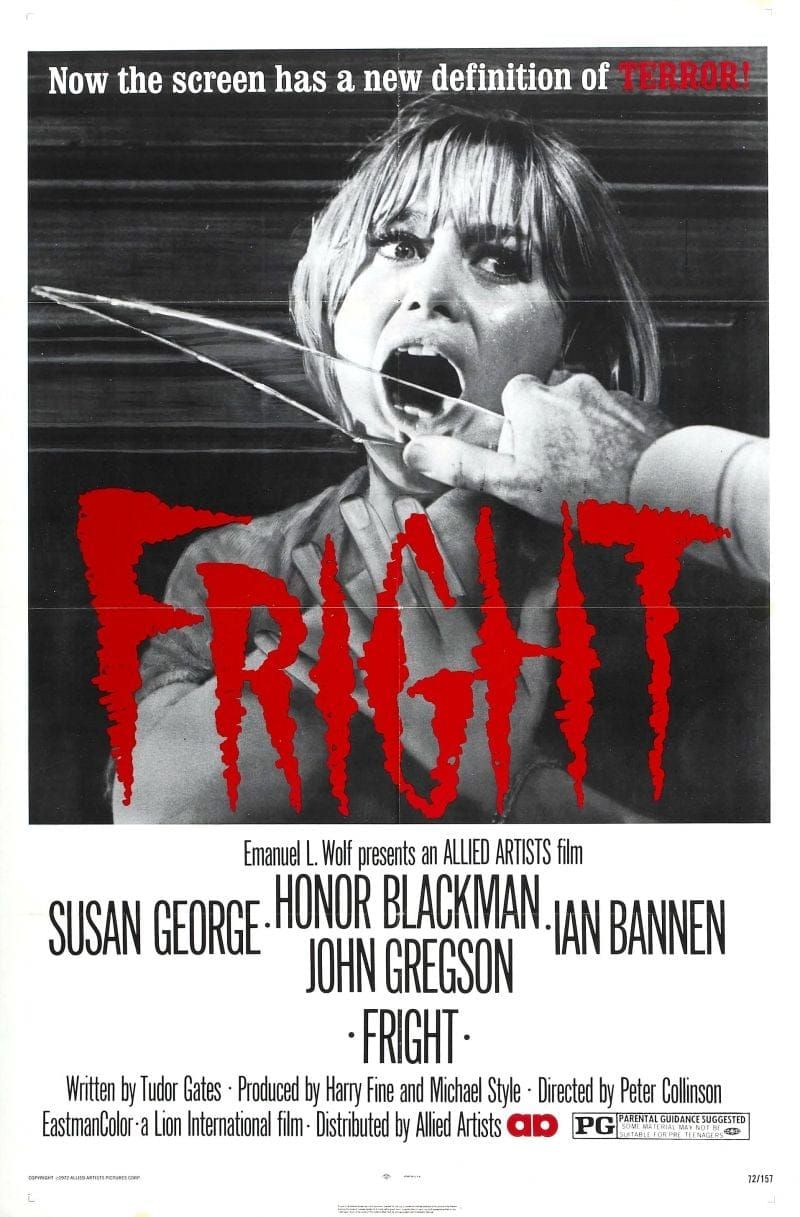
Plot: babysitter is besieged by an unseen assailant in a remote mansion.
The 1970s were a brave new day for horror at large as gritty and grimy suspense and terror instantly made the more classical horrors redundant. The age of the gothic had largely passed (although various regional revivals artificially prolonged its dwindling life.) Gone were the days of noblemen in decaying castles, of mad scientists engaged in clandestine experiments, and shadows scaring maidens witless. Alfred Hitchcock’s Psycho (1960) had breathed life into an entire subgenre that took about a decade to gestate before exploding in earnest. The influence, importance, and prominence of the once-glorious house of Hammer had waned drastically. Norman J. Warren and Pete Walker were the voices of a new generation and had their finger on the pulse of the youth. Fright was the product of few Hammer alumni deciding to put together their own little terror and suspense flick. If nothing else Fright is proof that a little can go a very long way.
The enshrinement of Susan George as a scream queen in the pantheon of British horror is somewhat mystifying upon consideration of the entirety of her considerable career. Like her contemporary Candace Glendenning she too never was a horror actress per se and in the strictest sense as its typically defined and understood. While she did her bit of exploitation and grindhouse churn most of her resumé is nothing of the sort. George’s first major roles were in the comedy All Neat in Black Stockings (1969) and the thriller Eyewitness (1970). That directly led into Pete Walker’s Die Screaming Marianne (1971) that paved the way for this little ditty. As per tradition, Hollywood came calling and Susan would star in the considerably more high-profile Straw Dogs (1971) from Sam Pekinpah. Her North American detour moved south of the border to México for the René Cardona Jr. Jaws (1975) rip-off Tintorera: Killer Shark (1977). Once back from her little vacation she did the action epic Enter the Ninja (1981) for Cannon which pretty much initiated the ninja and Shinobi craze in North America at large. To label George a horror queen would be reductive, historically revisionist, and disingenuous as it would painfully sell short both her considerable talent and the sheer breadth and width of the roles she played during her career.
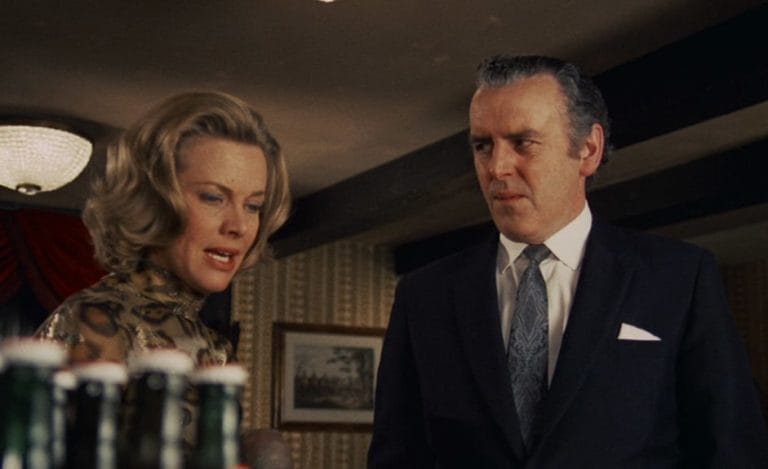
The other big stars here are Honor Blackman and Ian Bannen. Blackman was the goddess Hera in the big budget fantasy epic Jason and the Argonauts (1963) that featured pinnacle stop-motion animation from grandmaster Ray Harryhausen. To most, however, Blackman will always be Bond girl Pussy Galore from Goldfinger (1964). As most Bond girls Honor too didn’t ascend to superstardom and soon found herself another working actress with titles such as Twinky (1970) (also with George), The Cat and the Canary (1978), and the final Hammer horror To the Devil a Daughter (1978). The Bond girl curse is very real. Just look at Ursula Andress from Dr. No (1962), Daniela Bianchi from From Russia with Love (1963), Luciana Paluzzi from Thunderball (1965), Valerie Leon from The Spy Who Loved Me (1977), or a decade-plus later Talisa Soto from Licence to Kill (1989).
Ian Bannen was another monument from the Golden Age of Hollywood amassing an impressive 100-plus roles in a career spanning half a century. As a working actor he was frequently employed in Britain and was a regular on the big and the small screen. He traversed budgets and genres working on both sides of the Atlantic and with respectable directors as well as charlatans of questionable provenance. His body of work includes, among many others, The Flight of the Phoenix (1965) but he was soon lured into Italian exploitation with The Inglorious Bastards (1978) (of course Sylvester Stallone stole the very idea for his franchise from Italy. What did you expect?) and The Exorcist (1973) knock-off Ring of Darkness (1979). Bannen could later be seen in, among others, the biopic Gandhi (1982) and and the Mel Gibson historical dramatization Braveheart (1995). Blackman and Bannen did better things before and after Fright and like many a working actor they were happy just to be employed.
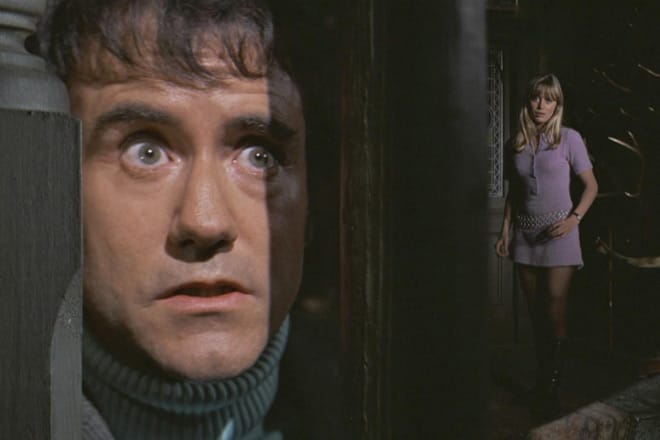
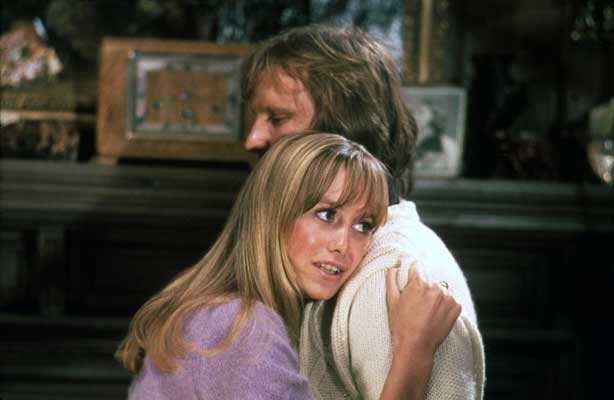
College student Amanda (Susan George) has traveled by bus to the remote mansion of the Lloyds on the outskirts of the city. As a student of child welfare and psychology it will be interesting to put the theory to practice and the extra money doesn’t hurt either. At the house she’s welcomed by an amiable James “Jim” Lloyd (George Cole) who makes small talk and his skittish wife Helen (Honor Blackman). She shows Amanda around the various amenities of the house and introduces her to their toddler son Tara (Tara Collinson). She informs Amanda that the house belonged to her late aunt and that her and Jim have been living there for a matter of mere months. In fact this will be couple’s first night out in a long time and Helen’s reluctant to actually leave. Amanda assures them that everything will be okay, re-locks the doors once Jim and Helen are out, and helps herself to a relaxing cup of tea. Having finally settled down in the couch the lights go out and strange noises emanate in and around the house. Composing herself Amanda goes outside to inspect and suddenly the doorbell rings. She’s startled to find her boyfriend Chris (Dennis Waterman) skulking around in the dark. Chris has one thing on his mind and Amanda is has no interest in giving in to him this night. Once she wrests free of his unwanted and unearned advances the two get into an explosive argument as Chris says that Amanda must be imagining shadows “creeping around the house” and that it’s probably “Mrs Lloyd’s husband.” Amanda realizes her suspicions are vindicated when out of nowhere a psychotic Brian Halston (Ian Bannen) appears at the door having escaped from a nearby maximum security facility (presumably Broadmoor). True terror sets in once he has parlayed his way into the house, and his homicidal psychosis erupts over the present whereabouts of his biological son.
Well, the first thing is that Susan George looks absolutely fabulous and far beyond adorable in that perfectly coordinated ensemble of a purple mini-dress replete with a golden hip-belt and virgin-white calf-boots. There’s that intangible sense of class and sophistication that you just don’t get with Luan Peters, Gilly Grant, Penny Meredith, or imported talent as, say, Yutte Stensgaard. While it’s true to an extent to call George the British counterpart to all-American girls Tiffany Bolling, Cheri Caffaro, or Arlene Farber it would also be doing her a grave injustice. Honor Blackman and George Cole make a believable aristocratic couple. Blackman in particular delivers a convincing performance as a defeated woman who visibly suffers in quiet resignation and obviously is on the verge of a spectacular nervous breakdown. Bannen’s performance is best described as uniformly psychotic and palpably unhinged. That just eight years later he’d be slumming it up and effortlessly chewing scenery in Ring of Darkness (1979) is nothing short of baffling. Since this was written, produced, and directed by a few Hammer associates it’s not strange that the movie Amanda watches on television is Plague Of the Zombies (1966). The decapitation scene that Chris enthusiastically describes in painstaking detail in all likelihood refers to the one in The Vampire Lovers (1970). The interior of the mansion looks more like an ornately designed mausoleum rather than the inviting and cozy abode it ought to be. The fact that almost every man George encounters is a creep proves that toxic masculinity is a malady of the ages.
More importantly, though, is the historical context and impact that it had. Nothing is ever without precedent and antecedent. Halloween (1978) wasn’t born of the fevered imagination of just one man and neither did it (or does anything, for that matter) happen in a vacuum. Halloween (1978) was the poignant product of the prior 8 years’ worth of terror and suspense exploitation (albeit in a timelessly elegant reconfiguration) synthesized into its most terrifyingly potent form. In that regard and historical context Fright is significant for giving the Carpenter feature its minimalist premise of a lone character assailed by an unseen force in an isolated location. The masked killer was introduced by either Wicked, Wicked (1973) and/or The Town That Dreaded Sundown (1976), depending on which one considers the more substantially relevant. The atmospheric Canadian thriller Black Christmas (1974) provided the holiday theme whereas the hopelessly inept law enforcement was lifted from The Last House On The Left (1972). Then there’s the fact that Fright is distinctly European in the sense that it’s more of a mini-Argento (albeit without the stylish bloodshed and innate sleaze) rather than a mini-Hitchcock. It certainly oozes with more than enough visual flair and exuberant style to make the Dario Argento comparison viable and fitting. This is the kind of terror and suspense Hammer should have been making at least since the late 1960s. This is the sort of thing that Fear in the Night (1972) wished it was if it weren’t so hopelessly hokey. Collinson was self-aware enough not to sell this as a giallo and it never professes to be one either. The only North American terror and suspense feature to do roughly the same thing as Fright and later Halloween (1978) would be the categorically chilling When a Stranger Calls (1979) but strictly that one doesn’t qualify as it only arrived a full year after John Carpenter’s masterclass.
The home invasion wouldn’t become an international subgenre of horror at large until The Last House On The Left (1972) and Fright had the good fortune of preceding that by some 12 months. As such it was early enough to profit from ongoing terror and suspense surge in North America as well as the nascent giallo boom in Italy. While it classified more as the former rather than the latter it never gets as down and dirty as, say, Night After Night After Night (1969) or something of similar ilk. Above and beyond anything else Fright is formidable exercise in minimalism and is blessed with an exuberant and psychotronic visual style that’s closer to the arthouse than to the grindhouse where it inevitably would end up. Perhaps history has not been as kind to Fright as it probably deserved. It’s a good little fright flick if you’re willing to meet it halfway. It might not quite be the classic as either the grindhouse extravaganza that was Wicked, Wicked (1973) or the atmospheric evergreen Black Christmas (1974). In all likelihood this is the closest Britain ever came to The Drifter in the Rain (1968).