Jaani Dushman (1979)

Plot: newly-wed brides keep disappearing in a rural village in north India.
No other Hindi horror feature has garnered the reputation that Jaani Dushman (or Sworn Enemy in most Indian sources we could find, IMDb insists on Beloved Enemy, and Google Translate puts it as Bitter Enemy - you decide which one is accurate) has. Not everyone might remember the movie itself, but some of its songs have become a fixture in Indian culture. Jaani Dushman heralded the new wave of Bollywood horror that veered away from white sari clad ghosts and into something resembling a Hindi take on gothic horror. It marked the Golden Age of Hindi horror that no longer modeled its productions after classic Universal Horror and Val Lewton movies of the 1930s/40s. It saw Bollywood embracing popular American properties and putting their own folkloristic spin on them. Jaani Dushman was a horror epic for the masses playing on age-old fears and prejudices and starring everybody that was anybody in 1979 Bollywood. If anything else Jaani Dushman is one of the most enduring and popular Hindi horror titles of all time, and the 2nd highest grossing movie that year. Jaani Dushman is a solid horror but was Nagin (1976) was superior by a wide margin.
Rajkumar Kohli started as a producer in 1969 with the box office hit Shart. In 1970 he made his directorial debut with Kahani Hum San Ki (1973). It wasn’t until the trendsetting Nagin (1976) that Kohli became commercially successful and a household name in the industry. Kohli usually concerned himself with ensemble cast fantasy epics. Jaani Dushman was an exception as a full-blown horror, obviously taking cues from Universal Horror and the its European forebears of the decade. However horror was typically the turf of the Ramsay clan, a dynasty of seven brothers, that catered to the tastes of small village crowds in rural towns. Cinema had the ability to speak to those that were ignored by traditional media: the illiterate, the superstitious, and the the religiously impaired. Jaani Dushman was produced for Shankar Movies by Kohli, presented by his wife Nishi and filmed in and around Chenani, Patnitop, and Udhampur in the Indian union territory of Jammu and Kashmir. Once again he took a figure of Indian folklore and put him in the then-present day setting of a rural village in 1970s India.
It’s a veritable ensemble cast of superstars with the likes of Jateendra, Sunil Dutt, Vinod Mehra, Roopesh Kumar, Prem Nath along with Mac Mohan, Raza Murad, Anil Kapoor, Sanjeev Kumar, Shatrugan Sinha, and Amrish Puri. There’s an abundance of absolutely ravishing blackhaired, huge eyed girls with wide hips, full curves, and narrow waists in the delectable form of Reena Roy, Rekha, Neetu Singh, Bindiya Goswami, Yogeeta Bali, Aruna Irani, Jayshree T. as well as Neeta Mehta, Shobhini Singh, and Aarti. Completing the cast are comedic duo Jagdeep and Paintal. This two-and-a-half hour horror tour de force preemptively opens with a handwritten disclaimer noting, “Jaani Dushman is a fiction film based on demons. This film has no message for those who believe in the supernatural. It makes no attempt to convert those who do not believe.” In other words, it does not judge either way, and plainly gives moviegoers exactly what they’re there to see: an all-star cast of Bollywood’s biggest names, half an hour of musical interludes featuring all the hit songs, and the romantic/comedic misadventures that people love.
North India, a remote farming village. On a particularly stormy night a man and his bride Geeta (Neeta Mehta) hurry into a taxi driven by a sinister figure (Mac Mohan). The car’s tires puncture, as they are wont to do, and the couple is forced to retreat to a nearby shadowy haveli (mansion) where the deceased owner speaks to the couple from out of a painted portrait. He then appears before them as a ghost and introduces himself as Jwala Prasad (Raza Murad), a local thakur. He relays to the frightened couple that he was poisoned by his thakurain and wife (Sheetal), dressed in a red bridal sari, on their suhag raat (wedding night). Ever since he has vowed to kill every bride in traditional garb he lays eyes upon. Scared witless the couple flee into a train where, after Geeta has dressed into something more bridal, they meet a disturbed man (Amrish Puri). He’s reading The Sixth Pan Book of Horror Stories by Herbert Van Thal paperback and has currently kidnapped a bride (Shobhini Singh). He imposes himself predatorily upon Geeta and explains in detail how one can recognize a victim of demonic possession: profusely sweating, lip biting, uncontrollable tremors, twitching eyes, and a fear of fire. Noticing her red sari he becomes possessed by Prasad’s dwelling spirit. After a protracted chase the man turns into a bhedia (or wolfman) (Anil Kapoor) trampling Geeta to death and then expiring himself.
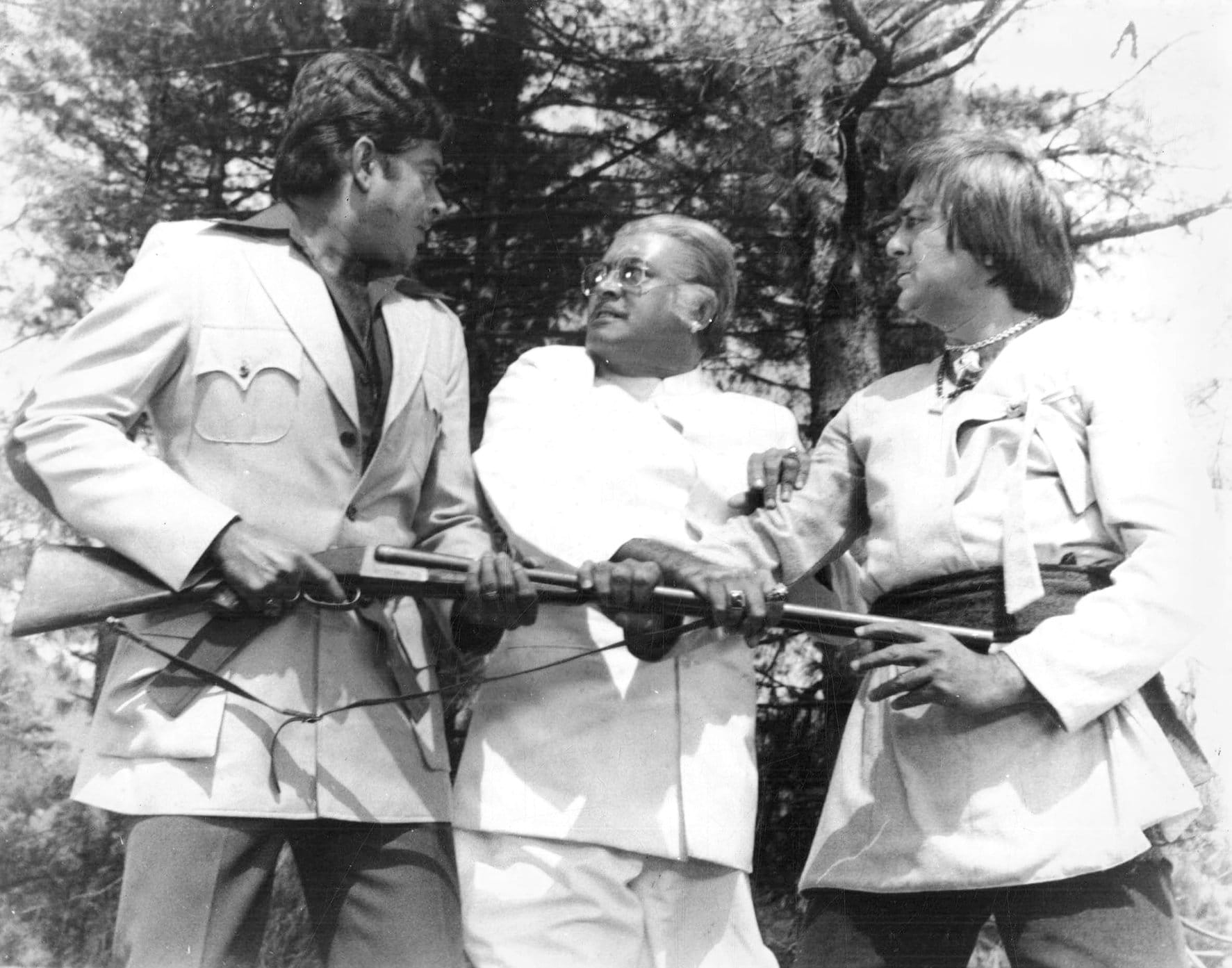
The town is now under feudal rule of the benevolent and just thakur Saab (Sanjeev Kumar) and his thakurain (Indrani Mukherjee, as Indrani Mukerjee). Lakhan (Sunil Dutt) is a simple farmer doing everything within his power to amass enough currency to marry off his younger sister Gauri (Neetu Singh) while courting Reshma (Reena Roy), a girl he’s head over heels in love with. Gauri has her own suitor in the form of Amar (Jateendra). Reshma is not the only girl in town that is in love with the strapping Lakhan, as is Shanti (Bindiya Goswami), the daughter of thakur Saab. Reshma meanwhile is prone to cross-dressing as a boy to be able to partake in gladiatorial contests on the thakur’s opulent estate and has thus attracted the attention of Champa (Rekha). Champa herself in love with Shera (Shatrugan Sinha), the arrogant philanderer son of the thakur, who looks down on Champa because she is of a lower class. The tug-of-war over the affections of Reshma bring Lakhan and Shera in direct conflict with each other. If that wasn’t enough, Nathuram (Jagdeep) and Nathaniya (Jayshree T., as Jaishri T.) are trying to find a quiet spot to make out, but they are constantly interrupted by rival suitor Gangelal (Paintal). To make matter worse thakur Saab has his own set of problems and hang-ups stemming from a family tragedy many years prior. On his sister’s marriage the groom was trampled to death by a horse, after which his sister (Yogeeta Bali, as Yogita Bali) committed suicide by throwing herself to death from the roof of the family haveli. Understandably Saab doesn’t take well, or at all, to seeing red bridal saris under any circumstance. For maximum confusion the town is also overrun by a madman (Vinod Mehra) but nothing is ever what it seems. Nobody is above suspicion. Not a heroic man (Shakti Kapoor) trying to save his bride nor the good pujari (priest) (Prem Nath). Is there a soul brave enough to enter the shadowy, torch-lit subterranean lair and stop the Jaani Dushman once and for all?
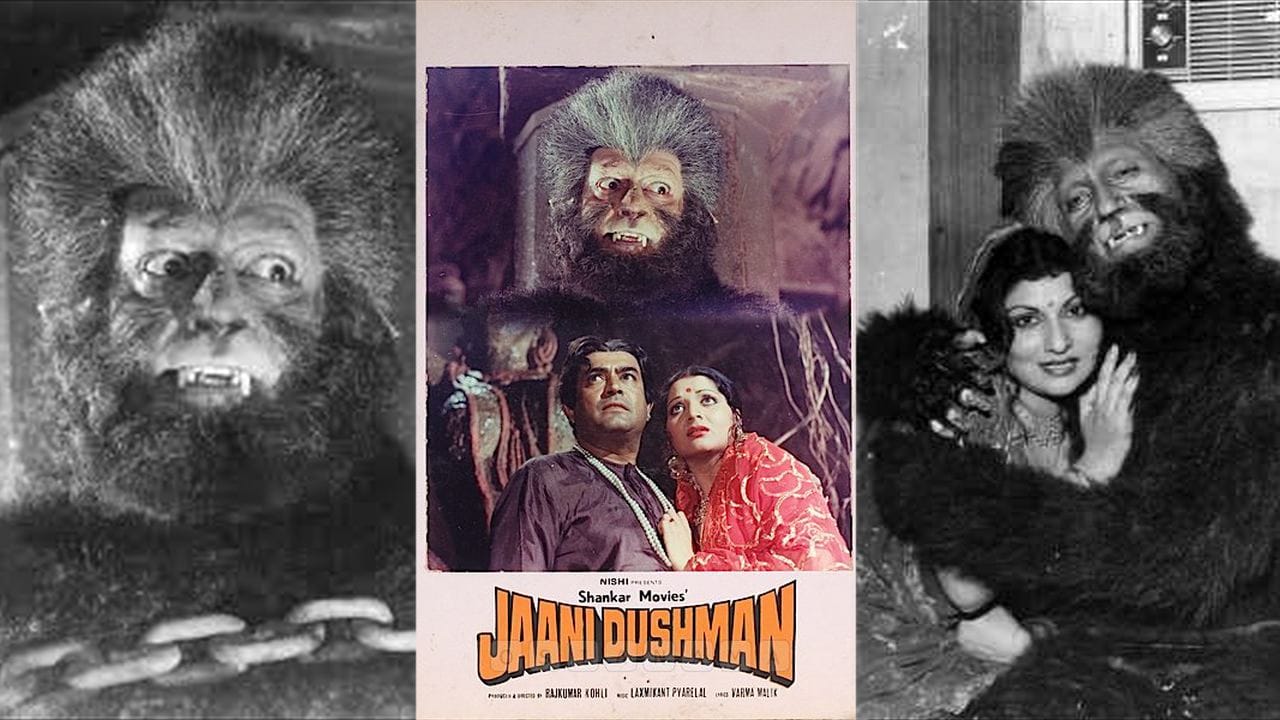
The screenplay by Jaggi Rampal and Charandas Shokh from a story by Hakim Riaz Latta (as Hakim Latta) is, true to masala and wider Bollywood tradition, convoluted and nearly inpenetrable. Jaani Dushman frequently loses itself in the adventures, romantic or otherwise, of secondary characters that are of no real importance to the mainplot. In fact the mainplot at various points becomes even completely inconsequential to the many amourous liaisons and courtships. Everybody is fair game as far as suspicions in regards to the werewolf’s identity - despite the fact it’s never even a mystery who is possessed by the evil spirit of thakur Jwala Prasad. Nevertheless an entire (and quite lengthy) subplot is devoted to casting suspicion on current thakur Saab. Jaani Dushman plays the supposed mystery completely straight. In one of the movie’s most memorable scene a red sari is brought before the thakur’s court, and without so much as a warning Saab experiences a psychological meltdown that reduces him to a profusely sweating, constantly twitching husk prone to fits of craziness that have him rolling around on the floor. The werewolf design from Bhanu Athaiya doesn’t defy description so much as it does convention, at least in the traditional Western sense. It makes Paul Naschy’s El Hombre Lobo look comparatively sane. The wild eyed Anil Kapoor not only wears a bear suit and a Boris Karloff alike make-up, this wolfman also sports vampire fangs and wields a trident. Unlike its Western counterpart the lycanthropic seizures aren’t caused by a bite or a curse, but are the result of demonic possession. Neither are they triggered by a freezing full moon but by external stimuli connected to the evil spirit’s past. The only way to exorcise the wolfman is by breaking the soul of the evil spirit. The wolfman transformation is accomplished piece time-lapse photography worthy of a Paul Naschy El Hombre Lobo or even Hammer production.
Above all else Jaani Dushman is a vehicle for early dhak-dhak girl Reena Roy. Roy gets to lipsync to a number of catchy songs written by Laxmikant Shantaram Kudalkar and Pyarelal Ramprasad Sharma with lyricist Varma Malik and singer Mohammed Rafi. Not only are the songs infectious and uplifting miss Roy can often be found dancing alongside whichever man she shares the screen with. It all becomes more impressive considering Roy was not a classically trained dancer. We particularly have a soft spot for the ballad 'Saare Rishte Naate Tod Ke Aa Gayi' ('She came after breaking all relationships', according to Google Translate) that she lipsyncs to Sunil Dutt. On a trailer compilation of his traveling b-movie festival De Nacht van de Wansmaak (The Night Of Bad Taste) Belgian filmmaker Jan Veheyen once legendarily described it as, “the ballad of a man… and his rifle!” As in Nagin (1976) Reena can be seen dancing in a river and waterfall. Roy – who played in better movies before and after this – wasn’t the only piece of desi eyecandy present this multi-star exercise of Bollywood in(s)anity.
Neetu Singh had blossomed from debuting as innucous child star Baby Sonia in the 1960s to the luminous, voluptuous vixen she is, and was, there and then. She was plump by Indian standards and in a cast rife with spellbinding curvaceous women her fuller figure stood out in all the right ways. A year later she would marry Rishi Kapoor and retire from acting altogether for a quarter of a century to raise a family. Bindiya Goswami married Vinod Mehra but their union disintegrated just four years later. She continued to act all through the next decade but retired once she married director J.P. Dutta in 1985. She became a costume designer and frequently worked with superstars Rani Mukherjee, Kareena Kapoor, and Aishwarya Rai. Whenever Roy or Singh start shaking their hips you’re bound to pay attention. Hips don’t lie, a Colombian heatwave Shakira taught us. Rekha was already a legend and is the subject of the movie’s funniest romantic subplot as she discovers during the thakur’s gladiatorial combat event that the boy she has been longing after is actually Reena Roy clad in black and with a pencil-thin Erroll Flynn/Clark Gable moustache. Yogeeta Bali is wasted on a tragic subplot that fleshes out the thakur’s backstory and Jayshree T. and her comedic subplot are so insignificant it might as well not be there. All the women often wear pastel colored lehenga/ghagra choli with exquisite make-up and jewelry. Sanjeev Kumar is memorable as the respected town elder, Sunil Dutt plays a lovable every-man, and Shatrugan Sinha shines as the prerequisite anti-hero. Raza Murad is has a blink-and-you’ll-miss-it cameo as the evil thakur during the prologue. Amrish Puri is the first to be possessed by the thakur’s cursed spirit and become lycanthropic.
India’s Central Board of Film Certification (CBFC) was ruthless with Jaani Dushman forcing director Kohli to file a petition in Mumbai High Court and awaiting the verdict he prepared different versions to secure its release. The movie poster shamelessly pilfered artwork from the Hammer classic Horror Of Dracula (1958). As any Bollywood production Jaani Dushman contains about 30 minutes worth of songs composed by Laxmikant Shantaram Kudalkar and Pyarelal Ramprasad Sharma, as mandated by distributors to ensure its commercial viability. The cultural impact was profound too. Two of the songs (‘Chalo Re Doli Uthao’ and ‘Oh mere Jaan’) topped the Binaca Chart of 1979. ‘Chalo Re Doli Uthao’ (or ‘Come on, lift the palanquin’) remains a staple at wedding ceremonies to this very day and in remote, rural villages the more superstitious still marry off their daughters in orange or pink saris instead of red. ‘Oh mere Jaan’ (‘Oh My Love’) is a duet (and a declaration of love) between Neetu Singh and her suitor Jateendra. ‘Tere Haathon Mein Pehna Ke Chudiyan’ (or ‘I want to wear bangles on your hands’) is generally more celebratory and festive sounding.
As it inevitably goes Jaani Dushman was the subject of a much protracted, and widely derided, infinitely inferior sequel/remake with Jaani Dushman Ek Anokhi Kahani (2002), from none other than Rajkumar Kohli himself and starring his son Armaan. Jaani Dushman Ek Anokhi Kahani (or Beloved Enemy: A Unique Story) was a rightly maligned and vilified in-name only sequel of the worst kind. It was a threadbare gender-swapped retread from the infinitely superior Nagin (1976) and obviously Kohli the elder couldn’t be bothered finding a suitable replacement for Reena Roy. For she was not easily replaceable. Sure, it starred Manisha Koirala from Dil Se.. (1998) and it’s maybe the only blemish on an otherwise stellar and exemplary career. No, this sequel not only arrived nearly a quarter of a century after the original, it was a much stranger beast still. It ripped off Terminator 2: Judgment Day (1991) and The Matrix (1999) simultaneously with a side dish of Mission: Impossible II (2000) for good measure. However, sequel or no, Jaani Dushman is more than just an epic all-star horror epic. It was obviously important and commercially succesful enough to bombard Amrish Puri to a potential Hollywood actor as it no doubt led to his appearance as the villain in Indiana Jones and the Temple Of Doom (1984). The rest of the cast, sadly, remained humble unknowns internationally. Suffice to say, Jaani Dushman was, is, and remains the stuff of legend even almost half a century later. If anything Jaani Dushman is proof that an established formula could be duplicated, even if the result was a less potent. And is there any way to resist Reena Roy, Neetu Singh, Rekha, and Yogeeta Bali?