Cryptopsy - An Insatiable Violence
While it was poet James Shirley who posited that death is the grand leveler it was Greek statesman and general Pericles who observed that time is the wisest counselor of all. For well-seasoned and battle-hardened Québecois brutalists Cryptopsy this rings more true than others. To say that the quarter century following the soaring commercial heights of “…And Then You’ll Beg” and the twenty years since Lord Worm’s second adieu following the abstractly technical and semi-conceptual “Once Was Not” (which harkened back to the glory days of “Blasphemy Made Flesh” and “None So Vile”, in ways both superficial and substantial) have been strange for Cryptopsy would be something of an understatement. If anything, they have seen the once-infallible band going from wreck to ruin with seemingly one distastrous decision after the next. “An Insatiable Violence” fits seamlessly with the Canadians’ wildly divergent post-2012 catalogue and is further evidence of why they haven’t been genre-leaders in well over twenty years. To its ever-dwindling credit “An Insatiable Violence” makes no qualms about what it is and delivers exactly what it promises. However meager those returns may be. More than anything, though, it is a thoroughly competent slab of overproduced extremity that sounds exactly like everything else on the scene today. As unthinkable as it may have seemed twenty-plus years ago, the call of the grave beckons.
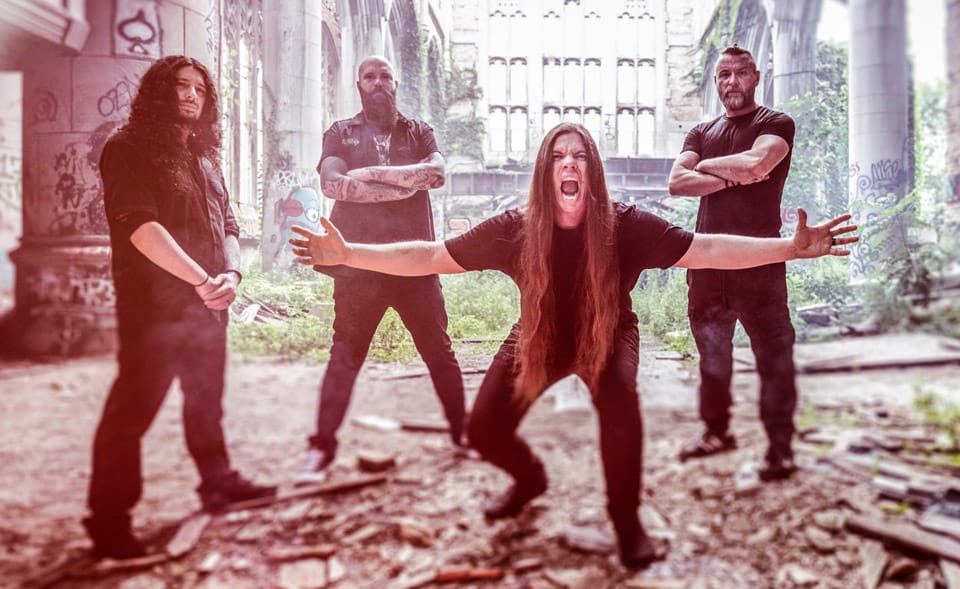
If the two decades since the French-Canadians last great hurrah have evinced something it’s the sobering realization that the new guys are now road-tested and dyed-in-the-wool veterans themselves. 20 years ago Christian Donaldson had the unenviable task of replacing original creative force Jonathan Levasseur (who himself was, at least for a new years, assisted and later superceded by Alexander Auburn and, on stage, by the ubiquitous Daniel Mongrain.) While Donaldson has certainly paid his dues and earned his keep as both a performer and producer he never wrote the most compelling riffs. For a band of this caliber, and in this particular subset of death metal, that is a problem. Not only is his note selection seldom very interesting the lack of any memorable hooks only compounds this further. Olivier Pinard has always been Cryptopsy’s unsung and underutilized hero of the modern age and a worthy replacement of Éric Langlois. And then there’s, of course, the often and rightly maligned Matthieu McGachy. He must be, without a doubt, the most indistinct voice to ever front a band of this magnitude. Oh well, "les goûts et les couleurs, on ne discute pas" and all that.
Lord Worm was the classic death metal vocalist and his charnel poetry is rightly revered. Mike DiSalvo, for all his hardcore trappings and limitations, brought a genuine percussive intensity and incendiary beatdown hardcore energy (his closest counterpart is probably Pete Ponitkoff from the now long defunct Benümb) that this current version is sorely lacking. Nobody is doubting McGachy’s competence or mastery of technique were it not that he sounds interchangeable with the frontperson of your everyday modern metal band. For our taste he gravitates far too often in the dreaded core side of the things rather than the death metal where he should be. Imagine what fireworks Cryptopsy could possibly conjure with risk-averse and conservative choices as former Neuraxis frontman Ian Campbell, ex-Kataklysm madman Sylvain Houde, former Brain Drill grunter Steve Rathjen, or even A.J. Magaña or Angel Ochoa from Disgorge. That’s not even contemplating modern powerhouses as Tanya Elizabeth Beickert (Monochromatic Black), Mollie Piatetsky (Closet Witch), or even the high priestess of powerviolence Madison Marshall (Cloud Rat). At the most basic level McGachy fullfills his role – but character he has not. This is not a renewed call for his dismissal but a rumination on what could have been, or once was.
Florent Mounier has been the only constant, he has remained unwavering in his commitment to the band he (re)shaped and inherited, and as the indefatigable engine he has propelled it forward through all the many trials and tribulations. The two-year turnover in between “As Gomorrah Burns” and “An Insatiable Violence” is as rare and exceptional as it is for this, or any other, established touring band with a considerable pedigree and/or extensive discography. While the funeral liturgies of the original Lord Worm era and the detour into socio-political criticism of the subsequent Mike DiSalvo years felt like a natural progression things have been going up and down ever since. The 2012 self-titled dealt with Canadian history and folklore and the two-part “The Book Of Suffering” set of EPs chronicled the lives and works of various domestic and international serial killers. A staple of the genre certainly, but the whole true crime aspect was never very interesting. This is supposedly Cryptopsy, not Macabre. It makes you wonder what morbid and moribund poetry, theological treatises, or necro-philosophical contemplations Daniel Greening could have adorned these with.
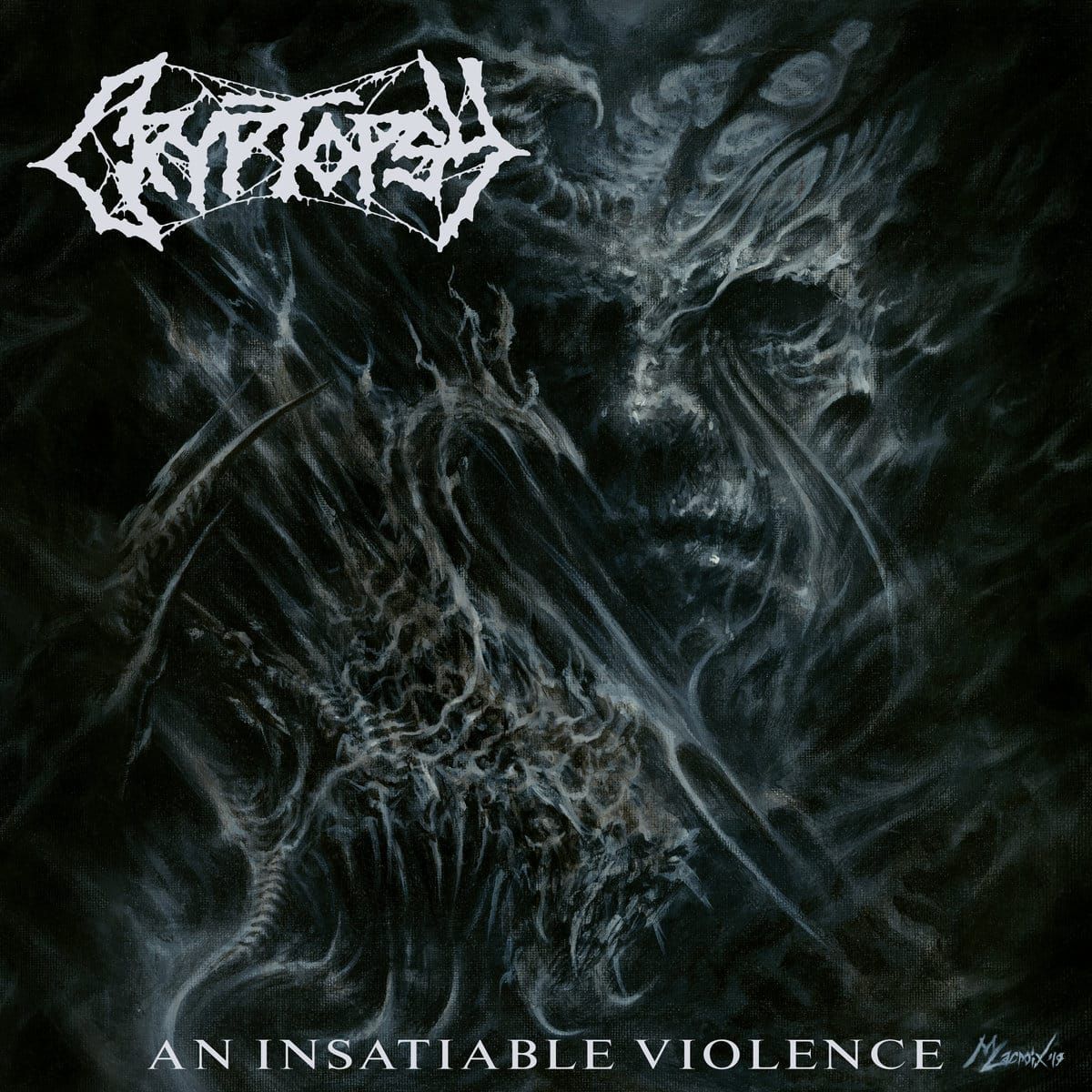
Like the lyrics there used to be a consistent throughline with the visual aspect and the artwork. In the halcyon days François Quévillon used to be their go-to guy, these days they are only consistent in their inconsistency. The 2012 self-titled was a dreadful low with something that resembled the Jack Daniel’s brand label. “The Book Of Suffering” duology was a marked improvement with the Remy Cuveillier artwork but couldn’t hold a candle to the work of the venerable Quévillon. This time the artwork was from the hand of late frontman Martin Lacroix (who fronted the band from 2001 to 2003, immortalizing himself on “None So Live” but whose mastery of the English language wasn’t strong enough to last beyond that recording). For “As Gomorrah Burns” they commissioned artwork from Paolo Girardi which they really should have done here. To capitalize on the nostalgia maximally they even invited the Voice of Unreason, Mike DiSalvo for some guest vocals on ‘Embrace the Nihility’. Merci beaucoup, les garçs, I’ll put on “Whisper Supremacy” or “…And Then You’ll Beg” instead. At this rate the next album probably will have artwork from Eliran Kantor, Jean Michel Lima, Simon Bossert, Marcelo Almeida, Giannis Nakos, Anastasia Ziazopoulou, Keerych Luminokaya, Anaïs Chareyre, Rudi Yanto, or Samuel Nelson; a guest guitar solo from either Luc Lemay (Gorguts), Tim Roth (Into Eternity), or Dallas Toler-Wade (Narcotic Wasteland, ex-Nile), and guest vocals from Sven de Caluwé (Aborted), Alissa White-Gluz (ex-Arch Enemy) or, possibly worse, Maurizio Iacono from Kataklysm.
Donaldson’s engineering has all the marvel of modernity and there is in fact such a thing as being too glossy and overproduced. It’s obviously richly detailed, digitally smooth to the point of being coldly clinical, and so clean it borders on sterile (which really is a generous way of saying there’s no human feeling to anything.) It’s as if Donaldson is desperately trying to recreate the futuristic, dystopian atmosphere and barbaric angular style that Myrkskog so brilliantly captured on “Deathmachine” a quarter of a century ago. Maximalist production really has become Cryptopsy’s undoing and they have been suffering from it for as long as Donaldson’s been around. How we long for the simpler days when this band recorded with Pierre Rémillard. Were these productions perfect? No, and that was exactly the point. They felt warm, organic, and human. How we miss the full-bodied, weighty drum – and bass guitar productions of “Whisper Supremacy” or “…And Then You’ll Beg”. Perhaps this is nostalgia talking but there used to be an aspect of unpredictability to this band and in their prime they used to sound truly unhinged and on the verge of collapsing in on itself. On “An Insatiable Violence” (as well as its predecessor “As Gomorrah Burns”) everything has been equalized, quantized, and sequenced as it were mathematical formulas and equations. Again, not that contemporary Cryptopsy is bad by any stretch of the imagination – it seldom moves us (we have a similar experience with present-day Suffocation where we prefer the classic Cerrito era over any of the reunion albums). As the decades have inevitably worn on and continual personnel changes the worst possible fate has befell the once mighty Cryptopsy. Alas, they now sound like every other death metal act.