Love Brides Of the Blood Mummy (1973)
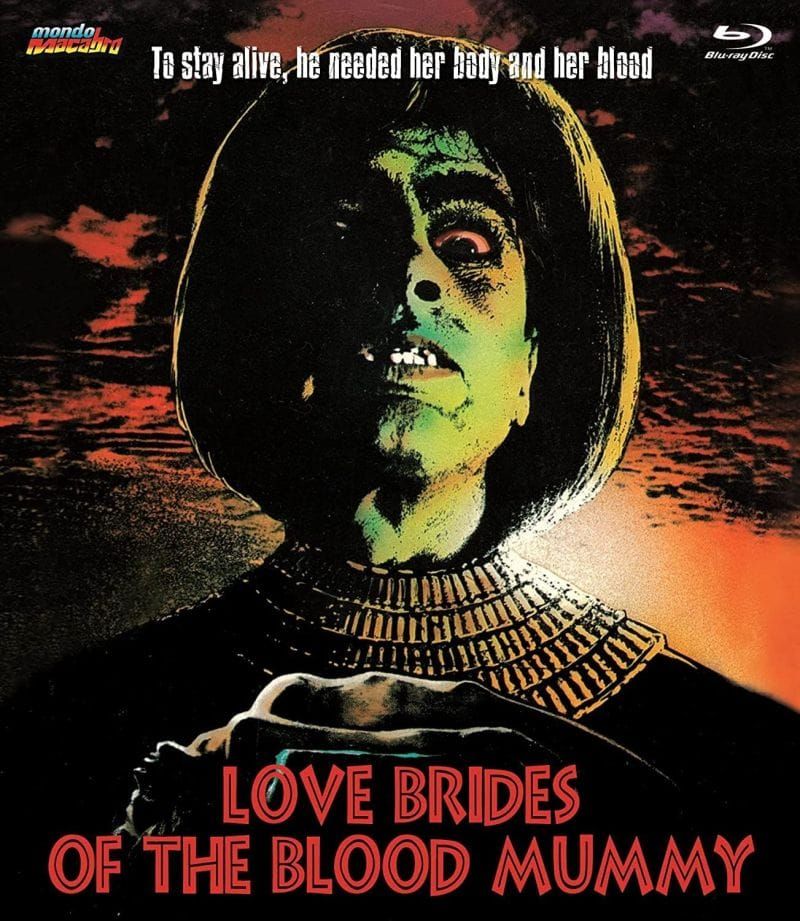
Plot: eccentric aristocrat revives ancient mummy and bloody murder ensues.
Within the annals of Eurocult at large, and more specifically within the scope of continental European gothic horror revivals of the 1970s, El secreto de la momia egipcia (or The Secret of the Egyptian Mummy) (released as Le sang des autres, ou la volupté de l'horreur or The Blood of Others, or the Voluptuousness of Horror and alternatively as Perversions Sexuelles or Sexual Perversions in an explicit cut for the French blue market, and internationally as Love Brides Of the Blood Mummy in a cold version) is an all but forgotten (and, at one point, considered lost) footnote – and rightly so. It’s compelling in its inherent strangeness yet completely deprived of pretty much everything that makes no-budget ditties of this era tick. No wonder something as trivial, futile, and ultimately forgettable as this fell through the cracks with competition in gothic horror as stiff and abundant as it was in the banner year that was 1973.
In that fertile post-Hammer period and in the wake of Jean Rollin’s success in the dawning decade producers and directors alike scrambled to get in on the fantastique and erotic-tinged vampire horror. Love Brides Of the Blood Mummy is a forgotten and forgettable little gothic horror that does indeed try but amounts to very little. As a by-product of the better known Hannah, Queen of the Vampires (1973) it is ostensibly described as Spanish and several cast members and director Julio Salvador (serving here only as writer) are indeed actual Spaniards. However this was a product conceived by French producer Jean-Claude Roblin with Eurociné, Pierre Chevalier, and Jésus Franco regular director of photography Raymond Heil, and director Alejandro Martí. Martí was a nobody then and nobody now. He functioned as a writer, producer, and this is the only instance of him directing. For good reason, probably because Love Brides Of the Blood Mummy is pretty fucking turgid most of the time. Despite its Spanish headlining stars Jorge Rigaud, Frank Braña, and Teresa Gimpera this has a majority French cast and crew. As a logistical compromise one assumes the exteriors were shot in France while the interiors were shot back home in Spain. The sort of thing that would have been vastly improved had it been handled by Paul Naschy, León Klimovsky, or Amando de Ossorio. French directors as Jean Rollin, Michel Lemoine, Mario Mercier, or Bruno Gantillon probably could have injected some magic.
In 19th century Cornwall, England police officer James Barton (Frank Braña), under the guise of being an Egyptologist, has journeyed to Dartmoor in southern Devon to investigate the strange going-ons at the local castle. The locals sternly warn him to steer clear of the castle as many have gone missing near its environs. Making his way into the castle Barton is mystified to find the earl (Jorge Rigaud, as Géorges Rigaud), half-mad with terror, whipping a disembodied hand chained to wall. The nobleman accuses Barton of having ulterior motives and threatens to turn him to stone with a mere touch. As a showcase of his fearsome supernatural powers he turns a stick of wood into a snake. Now sufficiently spooked the early sits Barton down relaying to him the details of the nerve-wrecking ordeal he barely survived and that resulted in the severed hand.
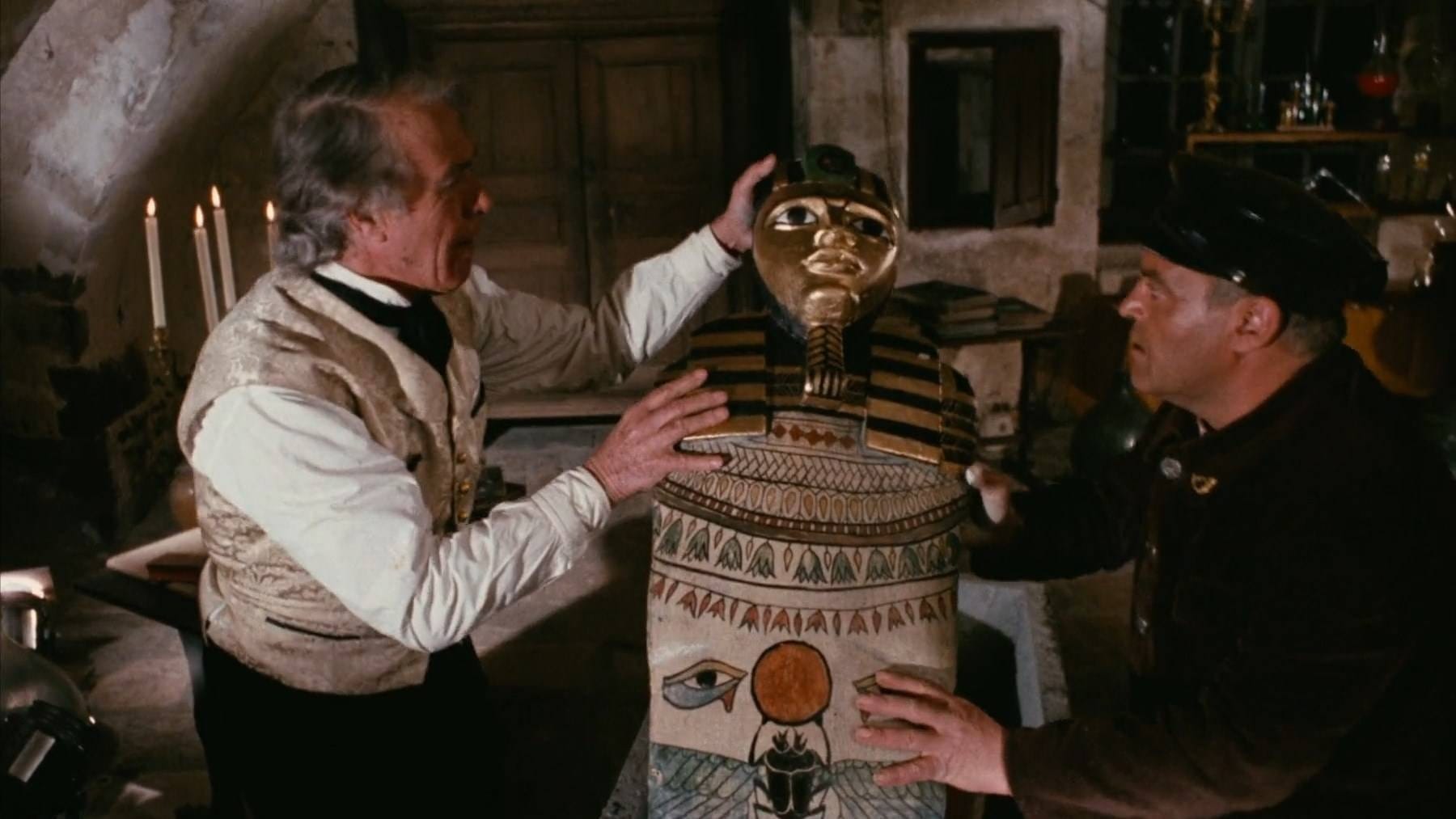
As an avid collector of Egyptian antiquities the earl was elated to receive a mysterious sarcophagus imported straight to England from the Valley of the Kings just two weeks prior. Upon inspecting the crypt he learns that the remains therein are that of a young Egyptian man, the son of a high priest, who was sentenced to cataleptic death for the murder and mutilation of an assortment of young maidens. Deciphering the hieroglyphics gleaned from a scroll he’s able to resurrect the perfectly preserved ancient (Michael Flynn) with a combination of electricity, zinc and copper. From an unfortunate lab accident the earl deducts that the Egyptian feasts on blood to keep his organs functioning. As a rational man of science the earl instructs his valet and administrator John (Martin Trévières) procure young women from the nearby moors to slake his insatiable bloodlust. Once synthetically revived the malefic Egyptian imprisons the earl in a iron-barred cell in the dungeon and telepathically enslaves John bending his will to do his bidding. Things become considerably complicated when the earl's nubile daughter Lucille (Catherine Franck, as Catherine Frank) and her equally attractive friend Anna de Bitbury (Teresa Gimpera) arrive at the old homestead.
Argentinian leading man Jorge Rigaud was firmly footed in continental European exploitation at this point finding steady work in Italy and Spain. After appearing in a number of westerns it was Lucio Fulci’s A Lizard in a Woman's Skin (1971) that granted him the opportunity to inhabit a popular niche as a leading man in gialli and for the next few years his career experienced an upsurge of sorts. In short order he could be seen in Death Walks on High Heels (1971), All the Colors of the Dark (1972), The Case of the Bloody Iris (1972), Murder Mansion (1972), and Knife of Ice (1972) that had him often crossing paths with the delectable Edwige Fenech, Rosalba Neri, Barbara Bouchet, and lesser queens of Italo pulp cinema. The Spanish gothic horror Horror Express (1972) signaled that his status of giallo leading man had passed. Spaghetti western pillar Frank Braña had been an immovable pillar in Spanish exploitation with credits ranging far and wide. He worked with Sergio Leone and Juan Piquer Simón. Clearly by 1973 his star had fallen and he was a long way from A Fistful of Dollars (1964), For a Few Dollars More (1965), The Good, the Bad and the Ugly (1966), and Once Upon a Time in the West (1968). Necrophagous (1971) was a point of delineation and from Hannah, Queen of the Vampires (1973) on he appeared in Iberian exploitation almost exclusively with such illustrious titles as Attack of the Blind Dead (1973), Alfonso Brescia’s Battle of the Amazons (1973), Journey to the Centre of the Earth (1977), the delirious Supersonic Man (1979), the late peplum The Cantabrians (1980), the slasher Pieces (1982), and Extraterrestrial Visitors (1983).
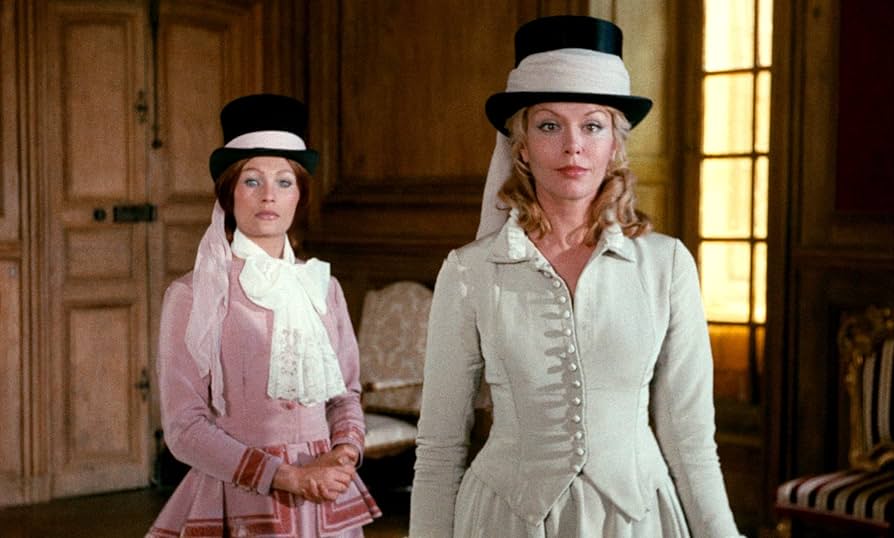
At least for a brief few years in the late 1960s Teresa Gimpera was the darling of director Vicente Aranda, or he of The Blood Spattered Bride (1972). That association gave her an explosive debut in the form of Left-Handed Fate (1966) and The Exquisite Cadaver (1969) allowed her a 60-year career spanning around 100 roles. Such is her fate that she appeared in nothing of real importance with the exception of the gothic horror The Night of the Devils (1972), the giallo Naked Girl Killed in the Park (1972), the vampire horror Hannah, Queen of the Vampires (1973), and the thriller Perversión (1974). In comparison the brief career of Catherine Franck is best described as negligible and inconsequential despite associations with Roger Vadim and José Bénazéraf. Lone American Michael Flynn was able to parly his wordless role here in a long career of playing smaller, non-leading roles on the big and small screen.
Not that Love Brides Of the Blood Mummy is lacking in inherent strangeness or occasional thick atmosphere. Connoisseurs will immediately notice that this feels Spanish, looks French, and has all the hallmarks of a decent gothic horror revival. It has mad science, a mummy on a rampage, enough bloodsucking for a vampire horror, a ravaging disembodied hand, and acres of skin! Under any other circumstance this would nominally make this one worth suffering through – but alas that’s not the case here. Things plod on uneventfully for a while before suddenly it briefly detours into a very loose Frankenstein adaptation with Dartmoor as the Baron, John as Renfield, Lucille as Mina, and Barton as Van Helsing. Stranger still, it has no reason to work but somehow does anyway. Night Of the Damned (1971), The Night Of the Devils (1972), The Witches Mountain (1972), Byleth: The Demon Of Incest (1972), and Seven Women For Satan (1976) did pretty much the same thing and did it better at that. The Spanish cut is expectedly chaste and modest to appease the repressive mores of fascist dictator Franco while the more liberal international cut has more than enough exposed female flesh to satiate Eurocult fans. Not even bare skin that redeem this one.
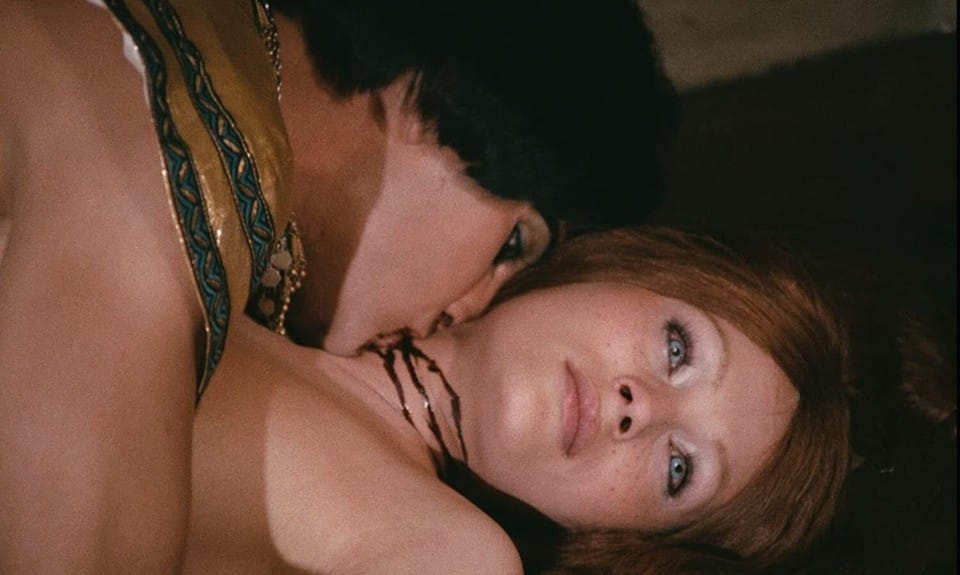
Love Brides Of the Blood Mummy is the definition (or rather embodiment, as that was it is very much lacking) of budget-deprived. This one was made with so little money it couldn’t afford any of imported stars (Helga Liné, Luciana Paluzzi, Dyanik Zurakowska, or Malisa Longo), established domestic stars (Diana Lorys, Rosanna Yanni, Cristina Galbó, Mónica Randall, Mirta Miller, Silvia Solar, or Patty Shepard), beloved supporting actresses (María Kosty, Emma Cohen, Cristina Suriani, Silvia Tortosa or Carmen Yazalde) nor persistent providers of exposed skin as Betsabé Ruiz, María Luisa or Loreta Tovar, or Inés Morales. Apparently there were so little francs that even the hiring French nude models as Marie-Pierre or Catherine Castel, Claudine Beccarie, or Joëlle Cœur wasn’t possible. Not often do you come across a movie for which Alice Arno, Caroline Rivière, Tania Busselier, or Kali Hansa were too expensive. In their stead are humble unknowns who undress and die. At least they got the most out of the locations. This makes The French Sex Murders (1972), Byleth: The Demon Of Incest (1972), and The Devil's Plaything (1973) look positively lush and expensive in comparison.
Love Brides Of the Blood Mummy is forgotten and obscurist for a reason. Not only it isn’t very good, but consider the competition it had. Hammer had completed the Karnstein trilogy with The Vampire Lovers (1970), Lust for a Vampire (1971), and Twins of Evil (1971). The Belgian-Canadian co-production Daughters of Darkness (1971) from director Harry Kümel was an international sensation. Italy and Spain had offerings as diverse and tittilating as Luigi Batzella had The Devil’s Wedding Night (1973) (with Rosalba Neri) and was one year away from deconstructing the subgenre with Nude For Satan (1974) (with Rita Calderoni). His contemporary Renato Polselli had delivered the ultimate denouement with Black Magic Rites (1973). Spain contributed Horror Rises From the Tomb (1973), the oneiric fantastique The Loreleys Grasp (1973), The Dracula Saga (1973) and its companion piece The Vampires Night Orgy (1973). Even the man who started the fantastique, Jean Rollin, was exploring other avenues and experimenting with mood pieces as The Iron Rose (1973). Suffice to say there was no way chance in Hell that Love Brides Of the Blood Mummy was in any shape or form capable of competing with international productions that strong. If anything, it can be considered a spiritual gothic precursor to Bernard Launois’ infamous Devil Story (1985). That should count for something.