The Etruscan Kills Again (1972)
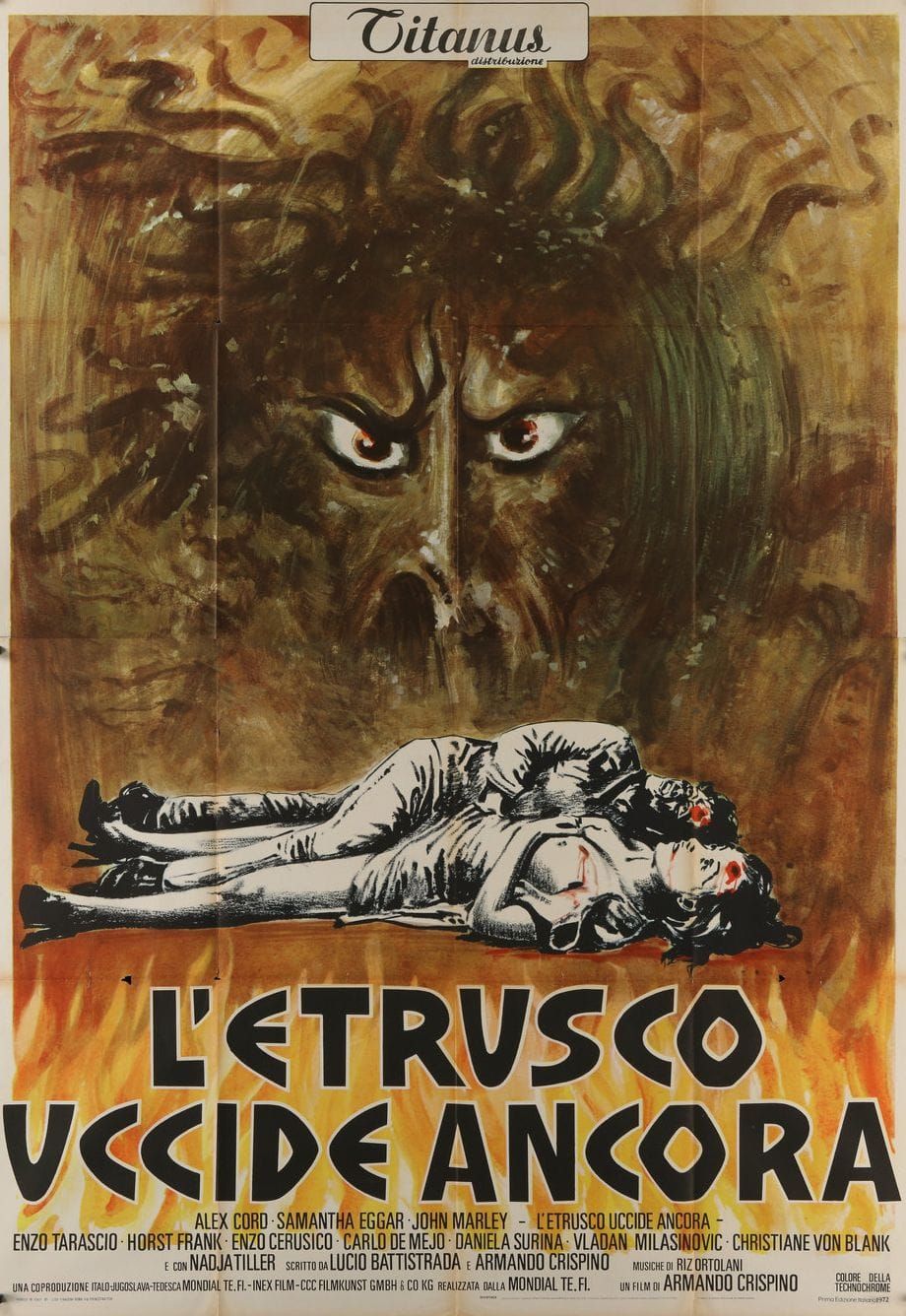
Plot: Etruscan burial site is disturbed by a spate of murders. Who’s doing the killing?
The Etruscan Kills Again (or L'etrusco uccide ancora back at home, and The Dead Are Alive! in North America) is an Italian giallo that in the grand scheme of things was of no real importance and was practically destined to fall into obscurity once it left theaters. While decent on its own merits it was hardly dripping with the exuberant decadence and hyper-stylized murder setpieces that the giallo usually thrives on. This was a German co-production so perhaps the more grounded nature of this isn’t that strange at all. Hardly anybody would remember (or talking about) The Etruscan Kills Again these days if it weren’t for the descent into Etruscan culture and tombs and the ensorcelment provided by the luminous presence of the peerless Christina von Blanc. Anybody wanting to explore the giallo might find a good entrypoint here.
To pinpoint the beginning of the giallo as a subgenre one must look at the career of Mario Bava. Bava first innovated the Italian film industry by providing the camera work, lighting, and special effects for the peplum epic Hercules (1958). He then further revolutionized the domestic movie industry by directing The Mask of Satan (1960), the first Italian gothic horror and one that led to a very prosperous international career for British import Barbara Steele. He then went on the made the Hitchcockian terror and suspense masterclasses The Girl Who Knew Too Much (1963) and Blood and Black Lace (1964) that were early prototypes for what later became the giallo. At the dawn of the following decade he contributed Hatchet for the Honeymoon (1970), and Five Dolls for an August Moon (1970) whereas Sergio Martino would launch Edwige Fenech to absolute giallo superstardom in the first half of the 1970s. By 1972 the giallo had become the next big thing and everybody was cashing in. This type horror was en vogue now and every two-bit director and halfwit producer wanted to get in on the action. There were good giallo like Naked Girl Killed in the Park (1972) but also turgid bilge as The French Sex Murders (1972). The Etruscan Kills Again is one of those unassuming little titles that’s easily overlooked during the emergent giallo boom.
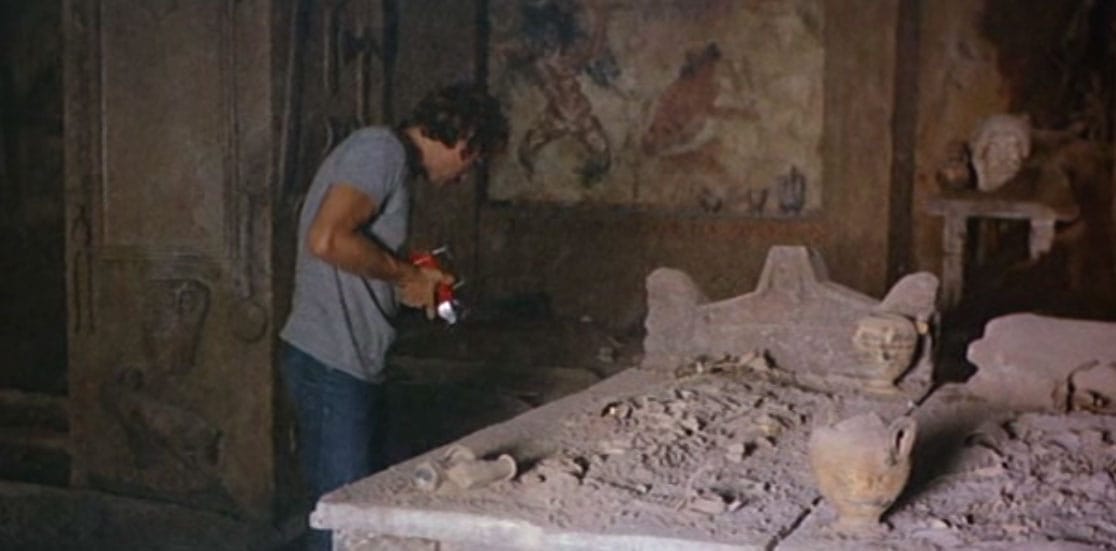
The Etruscan Kills Again is headlined by two American stars in Alex Cord and Samantha Eggar. Cord was in the American western Stagecoach (1966) and would find himself in Italy for A Minute to Pray, a Second to Die (1968). Cord would find fame on television with Airwolf (1984-1986), but we honestly had him confused with Spanish pulp mainstay Ray Lovelock. Eggar played in big studio productions in the sixties but by the following decade her starpower had plunged to such depths that she was forced to do exploitation just to keep working and put food on the table. In that capacity Eggar can be seen in The Brood (1979), The Exterminator (1980), Demonoid (1981) and, much later, redeemed herself somewhat with The Astronaut's Wife (1999). Carlo De Mejo was one of the pillars of Italian shlock but would really hit his stride when he got to work with Luigi Cozzi on Contamination (1980) which directly led him to Lucio Fulci and his zombie epics City Of the Living Dead (1980), and The House by the Cemetery (1981). A decade later De Mejo would return to his old stomping grounds with Murder In An Etruscan Cemetery (1982). In a much smaller but no less memorable part is Rodolfo Bigotti from the perennial Gloria Guida sex comedy classic The High School Girl (1975) and its first inferior sequel The High School Girl in the Class of Repeaters (1978). Rounding out the cast of consummate oldtimers are Nadja Tiller from Terence Young’s spy stinker Poppies Are Also Flowers (1966) in a rare lead role, and John Marley from Love Story (1970), The Godfather (1972), and It Lives Again (1978).
American professor Jason Porter (Alex Cord) has come to Spoleto in the Central Italian region of Perugia to document his expedition’s latest find: a 2,500-year-old Etruscan tomb containing murals and frescoes consecrated to the malevolent deity Tuchulcha. Porter - a recovering alcoholic that spent some time confined to a mental ward in New York and is both quick to anger and prone to sudden violent episodes - is none too pleased to see his former girlfriend Myra Shelton (Samantha Eggar) again and even less so that his dig is located on the property of her new husband, tyrannical orchestra conductor Nikos Samarakis (John Marley). The elderly maestro wastes no time in expressing his displeasure with the present arrangement as it disrupts his rehearsals for the annual Festival dei Due Mondi (Festival of the Two Worlds). When a young motorcyclist (Rodolfo Bigotti) and his girlfriend (Cinzia Bruno) are found brutally murdered and placed in the burial chamber as to resemble sacrifices to Tuchulcha this naturally attracts the attention of Inspector Giuranna (Enzo Tarascio) and Sgt. Vitanza (Mario Maranzana). Giuranna’s preliminary investigation yields circumstantial evidence incriminating Porter and he, erroneously or otherwise, becomes prime suspect in the ongoing investigation – but the list of persons of interest does not end there…
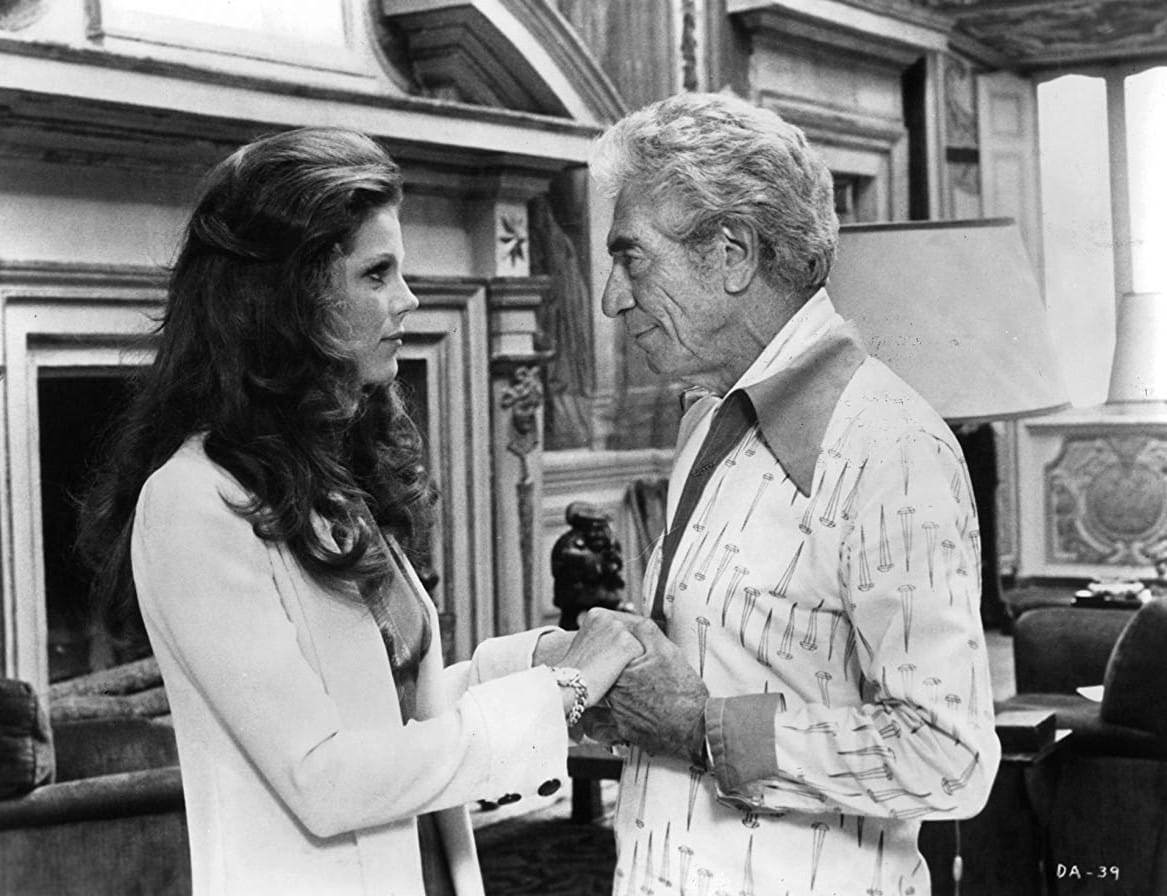
For starters there’s Nikos’ disgruntled ex-wife Leni Schongauer (Nadja Tiller) who didn’t take kind to being replaced with a young model, plus Nikos’ put-upon personal assistant and secretary Irene (Daniela Surina) has enough viable reasons to frame her employer. Nikos’ son Igor (Carlo De Mejo) is the black sheep of the dynasty for chosing archeology instead of following in his father’s footsteps and he’s only accepted in the family because of his socialite girlfriend Giselle (Wendy D'Olive). Flamboyantly and openly homosexual designer Stephen (Horst Frank) also has a habit of showing up wherever mutilated bodies happen to be found. Last but not least, there’s thuggish security detail Otello (Vladan Holec, as Vladan Milasinovic) who has taken to extortioning the American in hopes of swooning his girlfriend Velia (Christina von Blanc, as Christiane Von Blank). As the days pass and the killing spree continues unabated across Tarquinia and Cerveteri Porter realizes that it’s incumbent on him to not only to exonerate his name, but to uncover who’s the culprit. Has the excavation of the burial site provoked Tuchulcha, or is there a homicidal maniac in their midst?
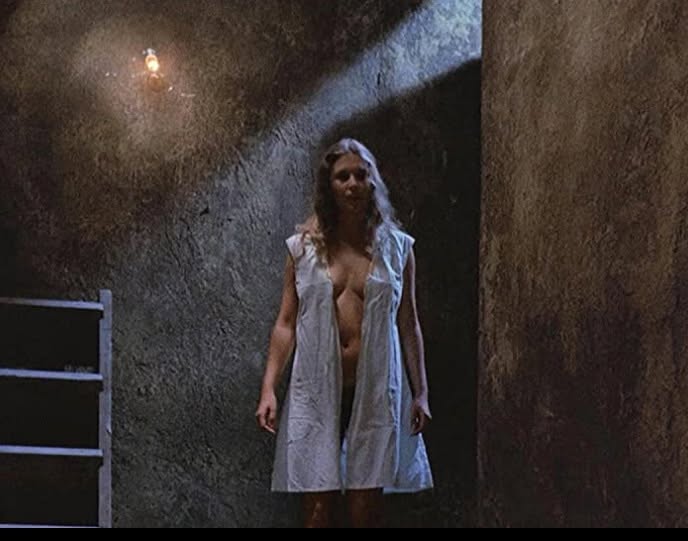
If The Etruscan Kills Again is remembered for anything, it’s for being the screen debut of German sex comedy and Spanish fantaterror icon Christina von Blanc. Her solitary and starmaking scene, at a record 76 minutes in no less, was radiant and illuminating enough to allow her to build a modest career on the back of it. Following the success of Schoolgirl Report (1970) fräulein Christina first ended up in Jess Franco’s Virgin Report (1972) only to legitimize herself with Hubert Frank’s Wedding Night Report (1972) and Claudio Guerín’s A Bell From Hell (1973). In cult circles von Blanc is mostly remembered for Jess Franco’s strangely enduring stream-of-conscious moodpiece A Virgin Among the Living Dead (1973), probably his best Vampyros Lesbos (1971) and Succubus (1968) approximation next to the illustrious Female Vampire (1973). It’s unbelievable enough that von Blanc’s career only lasted a mere two years. Even more criminal perhaps is that in that time she never ended up working with Renato Polselli, Bruno Corbucci, or Luigi Batzella. Provided with the right giallo script Christina could have been the new Edwige Fenech, Femi Benussi, Barbara Bouchet, or Rosalba Neri. Christina possessed tenfold the talent of Gloria Guida – and, for one reason or another, she never quite was able to consolidate her career. In Spain her closest counterpart Maribel Martín had a solid domestic career in exploitation. Just five years later Olivia Pascal would abundantly prove that there was a market for girls just like her. Von Blanc should have been picked up by Alois Brummer, Franz Josef Gottlieb, or Werner Jacobs.
Apparently German producer Artur Brauner and his CCC Films wanted to get in on the giallo phenomenon and recruited director Armando Crispino to direct one. Crispino was not one of the more prolific directors of the day with only 9 features to his name. His filmography runs gamut of westerns, decamerotici, comedies, as well as giallo. Bryan Edgar Wallace (or more specifically his late father Edgar) was extremely popular in Germany in the 1960s. Alfred Vohrer was something of a specialist in the subgenre, helming an impressive 14 adaptations – with master technician Harald Reinl contributing an additional 5. These adaptations were paramount in codifying the German krimi which made him a natural choice to film a giallo. Brauner assembled a largely Italian cast and crew with two American stars working locally and with inclusion of the hottest German starlet of the day. The screenplay alleges to be based upon one of Wallace the younger’s short stories, although curiously it’s never specified which. We honest to Odin believe that the Wallace connections are dubious at best and tenuous at worst. Brauner most likely used them to help lend legitimacy and to more easily market it to German audiences.
Perhaps more famous is director of photography Erico Menczer. He photographed for Federico Fellini, Mario Monicelli, Michelangelo Antonioni, and Dario Argento. He’s known around these parts for Eyes Behind the Stars (1978) and Tinto Brass’ wonderful ode to ass Miranda (1985). Riz Ortolani could always be counted upon to deliver marvelous scores and his music here is anchored by Giuseppe Verdi’s instantly recognizable “Requiem.” Apropos of nothing, the opening clubbing murder is similar to Argento's Four Flies on Grey Velvet (1971) and in an interesting break with tradition male killing victims far outnumber the slain female ones. This is not nearly as impressive as Brauner’s The Strangler Of Blackmoor Castle (1963) from nigh on a decade prior. That was both a visual feast and an excellent whodunit. This is closer to the gothic horror Cave Of the Living Dead (1964) in its lack of vibrancy.