Samoa, Queen Of the Jungle (1968)
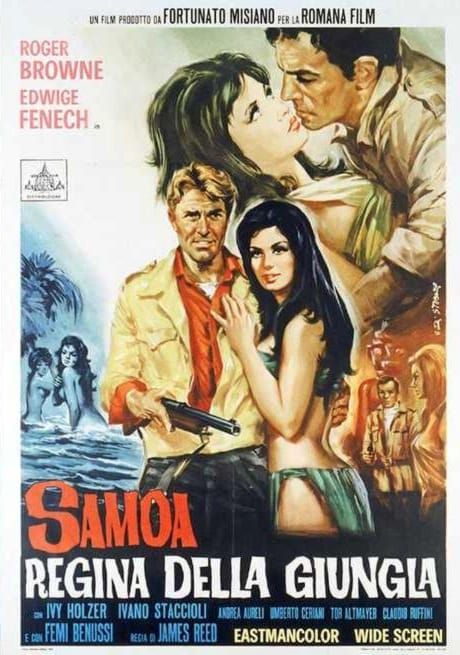
Plot: adventurers search for diamonds in Africa and find white girl instead.
The release of West German jungle adventure Liane, Jungle Goddess (1956) and its sequel Liane, White Slave (1957) was somewhat controversial. The film’s underage star Marion Michael appeared topless and both movies coincided with the series conclusion of Sheena: Queen of the Jungle (1955-1956) on syndicated US television. The box office success of Eduard von Borsody’s adventure flick signaled that perhaps it was time for a racier sort of jungle adventure. Just how Liane, Jungle Goddess (1956) came as a response to the timid Tarzan movies with Johnny Weissmuller Jr. from the thirties and forties this new breed would push the envelope as far as possible. Thus the next decade saw the likes of Danish import Kitty Swan as Gungala, Virgin of the Jungle (1967) and Gungala, the Black Panther Girl (1968); Mei Chen Chalais as Luana, the Girl Tarzan (1968), and Spain contributing the Harry Alan Towers production The Face Of Eve (1968) with Celeste Yarnall. Samoa, Queen Of the Jungle starred both Edwige Fenech and Femi Benussi, the latter getting her own with Tarzana, the Wild Woman (1969). These jungle adventures in turn would be made redundant with the arrival of Gualtiero Jacopetti and Franco Prosperi's Mondo Cane (1962) documentary which was directly responsible for the subsequent cannibal atrocity boom a decade hence.
Most cult movie chroniclers will correctly point to Man From Deep River (1972) as the starting point of the Italian cannibal movie, and that’s, indeed, correct. However, we are of the persuasion that it was in fact Argentinian jungle adventure Captive Of the Jungle (1969) (with platinum blonde sex bomb Libertad Leblanc) from Leo Fleider that provided the necessary impetus for the Italian antecedents to happen. If one was to look where most cinematic ur-characters and conventions (both of which were rooted in much older literature and comics) stem from Samoa, Queen Of the Jungle and Captive Of the Jungle (1969) suddenly become a lot more significant historically. Of the two the Libertad Leblanc vehicle is infinitely more exploitative in terms of bloodshed and nudity. Most of Leblanc’s movies were controversial, one way or another, but mostly due to the nudity and the subject matter. Argentina made the first cannibal movie under the guise of the then-fashionable jungle goddess romp. That so little is said of it speaks to its continuing obscurity. Spain contributed the jungle goddess adjacent Kilma, Queen Of the Jungle (1975) and Kilma, Queen Of the Amazons (1976) (with Eva Miller) comparatively late, arriving during a time wherein the cannibal atrocity movie was branching out into distinctly its own subgenre, one which in turn evolve parallel and distinct from the Italian zombie movie of the 1980s. To illustrate just how much a sign of the times the jungle goddess was Shaw Bros from Hong Kong felt compelled to include Evelyne Kraft as to reflect the changing Western cultural zeitgeist in their King Kong (1976) plagiate The Mighty Peking Man (1977). The Yeşilçam industry of Türkiye would only arrive a year later with Wild Lover (1978).
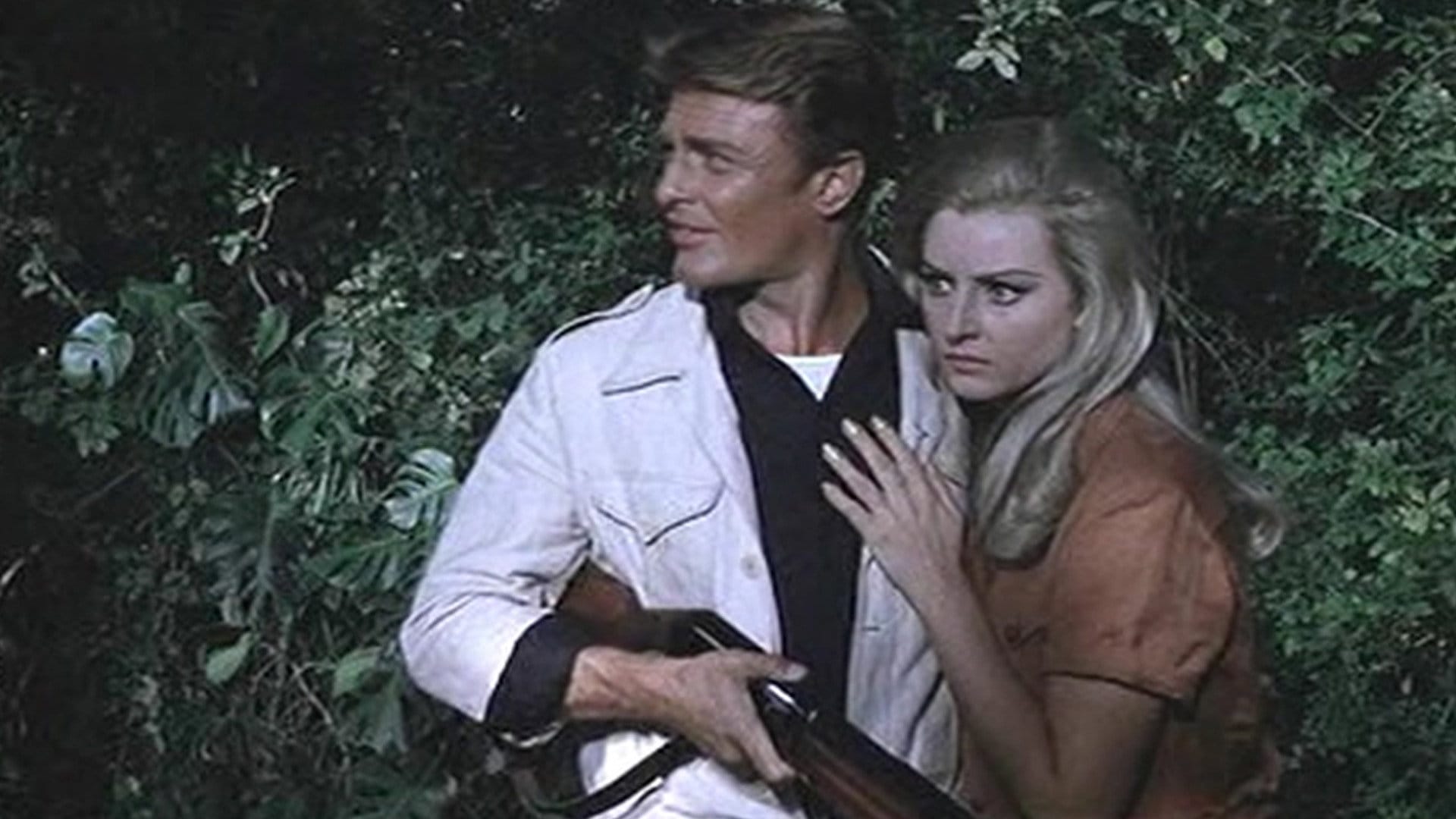
American adventurer Clint Lomas (Roger Browne) is ordered by a Malay benefactor to lead an expedition into Borneo to locate an alleged diamond mine. To that end he will be joined by geologist Prof. Dawson (Tullio Altamura, as Tor Altmayer), his assistant Nancy White (Ivy Holzer), medical professional Doctor Schwarz (Andrea Aureli), and native guide Akana (Wilbert Bradley). The scientists will be escorted by French and German mercenaries Pierre Moreau (Ivano Staccioli), Alain Duval (Umberto Ceriani), and Hans Müller (Ivan Basta), and head of transportation captain Santos (Gianni Pulone). When they do finally make landfall in Borneo (and not to the Polynesian island of Samoa in Oceania, as you’d expect, want, or hope) after a long, and mostly unpleasant, journey across the open sea the expedition starts to come apart at the seams almost immediately. Moreau has a predatory interest in young Nancy, the scientists are rebuffed at every turn by the cynical, gun-toting mercenaries, and a tribe of headhunters stalk the environs. After having settled for the night the next day the expedition is assaulted by a coordinated attack from the headhunters. The wooden sticks and spears of the natives are no match for the fast-firing rifles of the Western colonist invaders but the attack only ceases once a young woman materializes…
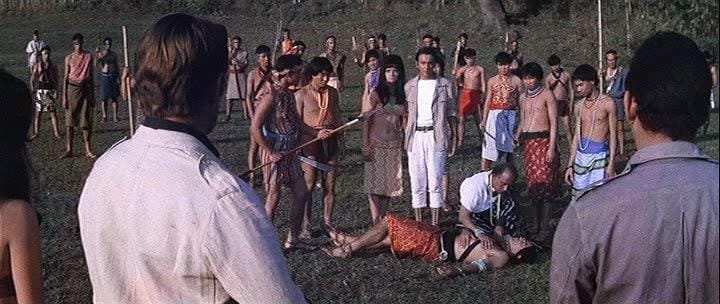
Her name is Samoa (Edwige Fenech), the milk-skinned queen of a nearby tribe, who’s friendly to the colonists’ acute and current plight. She orders her armed forces to chase the rival tribe into hiding and offers the strangers the safety of her adjacent village. Welcoming the colonists into her village Samoa almost immediately takes a shine to the rugged Lomas and from the gathered crowds of curious villagers Yasmin (Femi Benussi) catches a glimpse of Duval and is smitten. In the days that follow Lomas, Duval, and the expedition enjoy the hospitality of the natives – and it’s Prof. Dawson who insists they look for the diamonds. Alain Duval has adjusted to life in the tribe wonderfully, especially now with Yasmin at his side. And so it happens that in the following days the group take to sifting a nearby river and does indeed find a decent amount of diamonds. The loot is enough for Moreau and Müller to hatch a plan to betray the group and personally enrich themselves at the same time. When Lomas learns from Samoa that her tribe have harvested all the diamonds in the region and that they hold them as sacred stones in their cavern shrine, Moreau and Müller spring their plan into action. In the ensuing fracas the expedition falls victim not only to inter-personal frictions, but also to quicksand, poisonous snakes, and crocodiles. Ultimately, Samoa is forced to choose between her tribe and the imperialist colonists.
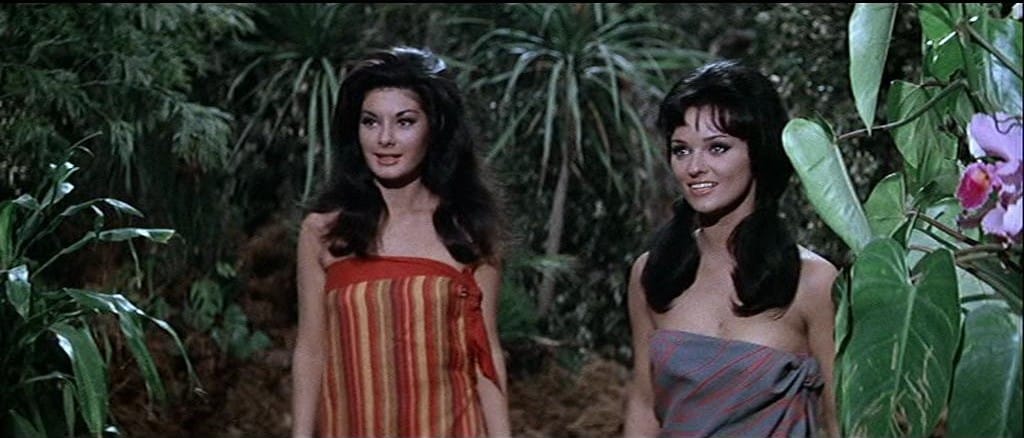
In her native France former model Edwige Fenech had just starred in the comedy All Mad About Him (1967) and the year before she had moved her base of operations from Nice to Rome, Italy to star in Samoa, Queen Of the Jungle. Edy had just inked a deal with Austrian director Franz Antel and she was bound to appear in a number of his comedies. Not only that she was contracted to do two features for Guido Malatesta as well. In between the two The Hostess episodes from Antel, Edy somehow managed to squeeze in a star-making appearance in the offshore giallo Top Sensation (1969). From there Fenech starred in a number of German comedies before reinventing herself in the 1970s as the giallo and comedy queen par excellence. The second rising star was Femi Benussi. Benussi had officially debuted three years earlier with A Maid For the Prince (1965) and made a splash with Bloody Pit of Horror (1965). She was a minor staple in spaghetti westerns and comedies before too venturing into the giallo. Allegedly, Benussi’s first role of note was as one of the many ballerinas in The Vampire and the Ballerina (1960) although it was never officially confirmed. Just like Fenech, Femi too would become a pillar of commedia sexy all’Italiana, and figure into a few noteworthy giallo of her own. Roger Browne was an American actor who worked in Italy, and when the peplum dried up he became a fixture in the burgeoning Eurospy genre. Some of his more memorable roles include Vulcan, Son of Jupiter (1962), Argoman the Fantastic Superman (1967), and the Alfonso Brescia craptacular War of the Robots (1978). Compared to her co-stars Ivy Holzman was a relative unknown who’s perhaps most remembered for her role in Alfonso Brescia’s lovably insane peplum Revolt of the Praetorians (1964).
Like his colleagues Tito Carpi, Piero Regnoli, and to a lesser degree Cesare Frugoni, Gianfranco Clerici was a workhorse writer and occasional second unit/assistant director who could be counted on to produce decent screenplays for whatever genre was popular. In an interesting turn of events Clerici, and two directors with whom he was closely associated would come to play a pivotal role in codifying the Italian gutmuncher. These men were Gungala, the Black Panther Girl (1968) director Ruggero Deodato, and shlockmeister Umberto Lenzi for whom Clerici had written Last Man to Kill (1966). Lenzi got the ball rolling with his Man From Deep River (1972) and Deodato infamously one-upped him with Last Cannibal World (1977) and Cannibal Holocaust (1980), both written by Clerici. Lenzi in turn rode the genre into the ground with the double-whammy of Eaten Alive! (1980) and Cannibal Ferox (1981) by which point Eurociné and the inevitable Jess Franco even decided to dabble in the genre. When there was easy money to be made Eurociné and Franco could be relied upon to quickly throw something, anything, together to capitalize on whatever the trend was.
And it’s really interesting how Umberto Lenzi’s Man From Deep River (1972) tweaked the established jungle adventure formula just enough to launch an entire subgenre. The jungle goddess in question was Me Me Lai, and she would do the same thing again in Ruggero Deodato’s Last Cannibal World (1977). It takes but a second to see and hear the faint jungle goddess shades and echoes in offerings so wildly diverse as Emanuelle and the Last Cannibals (1977) (with Laura Gemser, Nieves Navarro, and Mónica Zanchi), Zombie Holocaust (1980) (with Alexandra Delli Colli and Sherry Buchanan), White Cannibal Queen (1980) and Daughter Of the Jungle (1982) (both with Sabrina “my ass is bigger than hers” Siani), the Eurociné romps Diamonds Of Kilimandjaro (1983) (with Katja Bienert) and Golden Temple Amazons (1986) (with Analía Ivars) as well as Antonio Climati’s relatively humane The Green Inferno (1988) (with one-timers May Deseligny and Jessica Quintero). Everybody got in on the cannibal game (which was primarily an Italian practice) with contributions coming from France, Spain, and Indonesia.
By most metrics Samoa, Queen Of the Jungle is very much a product of its time and on the modest side (especially when you see the sanitized television cut). Considering its 1968 release the slightly spicier international cut ramps up the psychotronica and nudity just in time to profit from the impending Sexual Revolution the next year. Gungala, Virgin of the Jungle (1967) was more sensationalist and risqué than this relatively harmless genre piece. This being a 1960s jungle adventure the focus is squarely on the still-unexplored and pejoratively dubbed Dark Continent or present-day Sub-Saharan Africa. Southeast Asia and Latin America would only become of geographical importance and interest in the following decade.
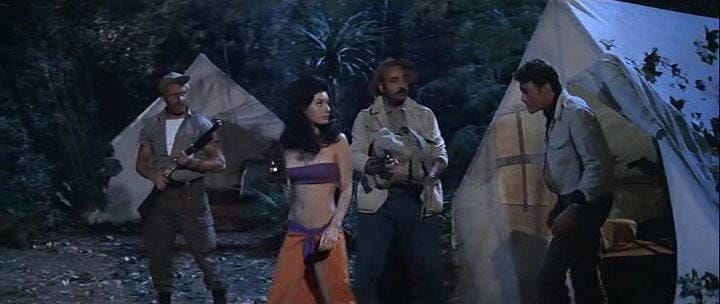
The ladies Fenech, Benussi, and Holzer are given at least one nude scene each and to even things out, Browne is often shirtless too. It all stays within the realm of the respectable, and even the extended shoot-out against the headhunters is practically bloodless despite the copious exchange of gunfire. It was a different time after all, and it’s here that Samoa, Queen Of the Jungle reflects just how much it was indebted to the safari jungle adventures and westerns of the decade before. The lead women’s tribal garb often looks like slightly reconfigured spaghetti western Indian attire; especially the bright colors, headgear, and stripe patterns that turn up everywhere. If Samoa, Queen Of the Jungle (1968) looks somewhat similar to Gungala, Virgin Of the Jungle (1967) that’s probably because director of photography Augusto Tiezzi, composer Angelo Francesco Lavagnino, and supporting actress Antonietta Fiorito were in both. At heart this really is a spaghetti western, where a group of grizzled hired guns ride into a besieged town to protect it and its riches from roving gangs – and the men fall in love with the prerequisite town belle, saloon girl, or pretty Indian virgin. A decade and a half later the post-nuke action genre would abide by much of, if not all the same, rules.