Geisha Assassin (2008)
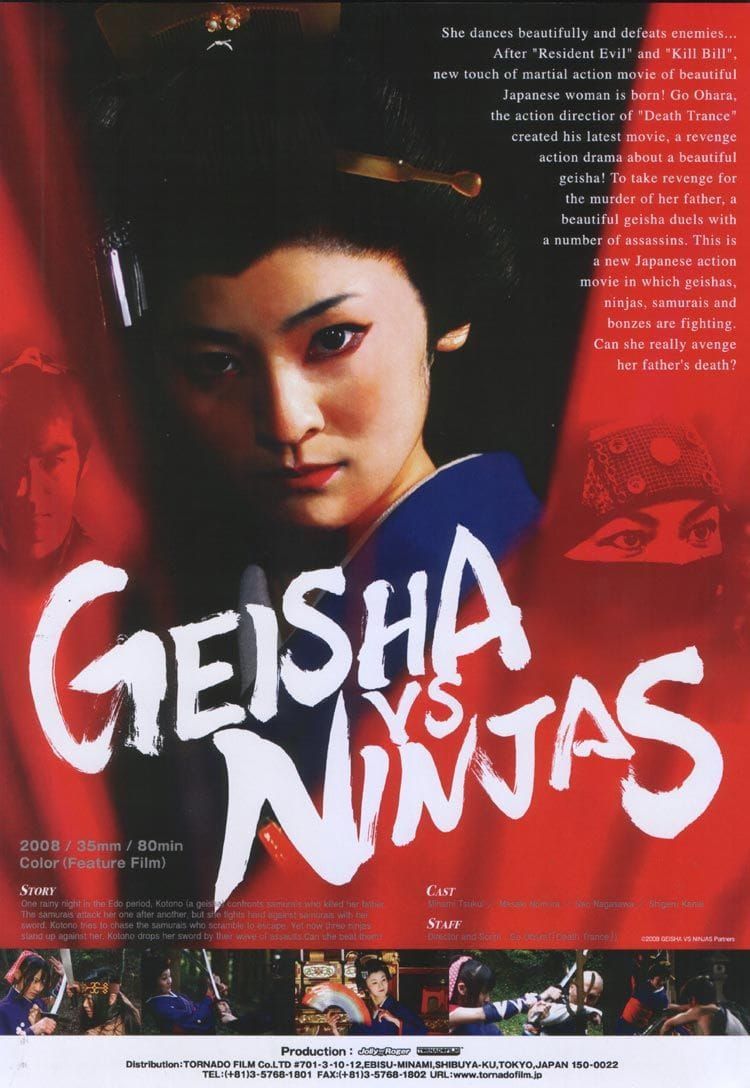
Plot: sword-wielding geisha vows to avenge the death of her father.
芸者VS忍者 (or Geisha VS Ninjas, released in the English-speaking world as simply Geisha Assassin) is a low budget chanbara (チャンバラ) and jidaigeki (時代劇) (or a swordfighting and period drama, respectively) that largely exists as a showcase for the action direction, fight choreography, and efficient splattery effects. Geisha Assassin never professes to have much of a story to tell or to have any aspirations beyond what it initially lays out, and that’s okay. Most of the times, less is more – but sometimes less is indeed just less. In this particular case perhaps something more could have been made of Geisha Assassin had it bigger ambitions than just being a thinly-veiled stunt demo.
The first, only, and most obvious question first: who exactly is the Geisha Assassin? Well, that would be experienced martial artist, stuntwoman, dancer, and sword fighter Minami Tsukui (佃井皆美), a graduate of Japan Action Enterprise (JAE) (famously found by martial arts pillar Sonny Chiba in 1970 as Japan Action Club)’s 37th class. Her affiliation with JAE lasted until 2020. Currently she’s represented by WINTARTS. Tsukui has performed many action-oriented roles as a suit actor for various tokusatsu and super sentai series. She known for her roles as Yoko Minato/Kamen Rider Marika from Kamen Rider Gaim, Chie Satonaka from VISUALIVE Persona 4, and Suzu Minase from Revue Starlight series. Tsukui later would star in the largely similar Gothic & Lolita Psycho ゴスロリ処刑人 (2010) and landed a minor part as Epsilon in 009-1: The End of the Beginning (2013). Among her admirers are esteemed JAC seniors Etsuko Shihomi (志穂美 悦子) and Yukari Oshima (大島由加利). When you get the seal of approval of Sister Street Fighter (1974) and an associate from the foremost of Iron Angels (1987-1989) - Moon Lee Choi-Fung (李賽鳳) who are we, mere fallible mortals, to argue?

In 2018 Minami-san was the featured dancer "Minami Metal" during The Chosen Seven (along with Minako Maruyama, Shōko Akiyama, Saya Hirai, and Kotono Ōmori) era/storyline on the "Dark Night Carnival" stage show production as part of Babymetal's Apocrypha World Tour of 2018. She was the one performing the karate fight on ‘Karate’ we’re assuming/guessing based on the facile otaku/kawaii stereotypes that Babymetal has centered its entire brand around. This extra show at the Saitama Super Arena in Tokyo was recorded for posterity. There were apparently no plans by Suzuka Nakamoto (Su-metal), Moa Kikuchi (Moametal), Momoko Okazaki (Momometal) (who replaced Yui Mizuno or Yuimetal following her absence in 2017 and eventual health-related departure in 2018, winning from Kano Fujihira and Riho Sayashi) or their management to make her a permanent dancer. As recent as 2025 she was part of the stage adaptation of the anime Musical Fate/Zero: The Sword of Promised Victory.
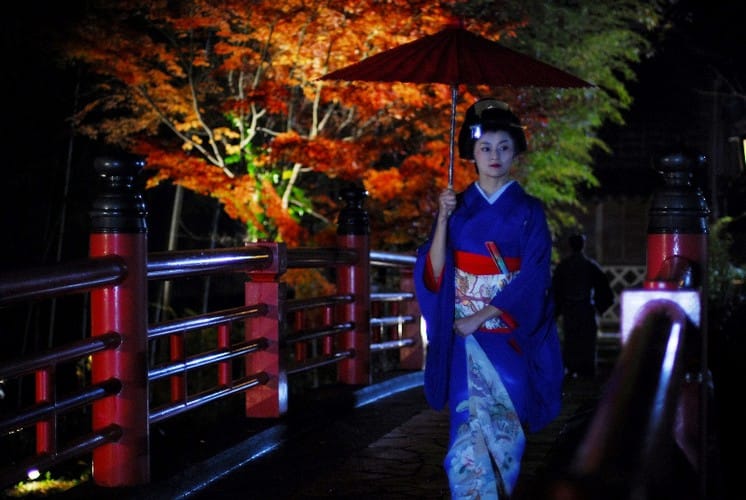
In ancient Nippon (present-day Japan) during the Edo period (1603–1868) umbrella-bearing geisha Kotomi (Minami Tsukui) walks home from an appointment at night. During her nocturnal stroll she encounters Katagiri Hyo-e (Shigeru Kanai) who she recognizes as an erstwhile student and the slayer of her father Shugoro Yamabe (Masaki Nomura). Kotomi has solemnly sworn to exact revenge on the man responsible and challenges him to a duel. Katagiri refuses to oblige her and matter-of-factly informs her that she’s not in any shape or form ready to face him. The masterless samurai instructs her to prove her woth by defeating all his underlings that lie waiting scattered across the lands. With steel-eyed determination she declares that anyone and everyone who opposes does so at their own peril and will be subject to consequences. As she navigates the lands and weathers the elements Kotomi faces ninja woman Kumiichi (Nao Nagasawa), wandering monk Toji (Taka Ôkubo), warrior monk Go-an (Satoshi Hakuzen), the Ainu woman (Kaori Sakai), and finally the rōnin Ronin (Yasuomi Ōta). Is Katagiri Hyo-e your garden variety murderous cretin, or does he hide a terrible secret that might shatter Kotomi’s vision and have her abandon her quest of revenge?

As can be deduced from the above synopsis there isn’t as a plot or any real story here. The impact of Crimson Bat, the Blind Swordswoman (1969) resonates on forty years later. This was released the same year as Ichi (2008), the heir apparent of that particular legacy, and something as futile as this was easily eclipsed by that. There’s a throwaway opening scribble explaining the word “geisha” and how its meaning changed from the Warring States period (1185-1603) to the Edo period (1603–1868) but it offers no meaningful additional value. Kotomi’s backstory (and the entire premise with that) amounts to a scant three lines in total and the fighting is on. Geisha Assassin hinges upon the thinnest premise, and that’s about it. It’s efficient in its stark utilitarianism but it’s as minimalist as features as this get. There some resemblance to Everly (2014), but not even Salma Hayek could save that one.
Minami Tsukui acquits herself admirably enough but she’s clearly no Meiko Kaji (梶 芽衣子) or Haruka Ayase (綾瀬 はるか). Geisha Assassin is a mere preamble for an exhibition in stuntwork and swordplay. The action direction and fight choreography are pretty good considering the miniscule budget this was on. The period costumes and locations betray the budget but are decent for what they are. Cheap keyboards and synthesized strings account for much of the score and they have been the scourge of low budget swill like this at least since the mid-to-late 1980s. To its limited credit, this is not as outright splattery as Stacy: Attack of the Schoolgirl Zombies (2001) or any J-horror from around this time. Which isn’t at all bad per se since story-free gore is not only terminally boring at best and completely pointless at worst. In all honestly, that year we were emphatically and pathologically enamored with the swooning epic romance My Girlfriend Is A Cyborg (2008) to pay fodder like this any mind. Suffice (and a bit redundant) to say Lady Snowblood 修羅雪姫 (1973) this not. In truth this is closer to the Taiwanese chunkblower The Challenge of the Lady Ninja (1983) from a quarter century before.
Apparently this was the debut directorial effort of action director and stunt coordinator Gô Ohara. He would further expand upon the concept with Gothic & Lolita Psycho ゴスロリ処刑人 (2010) that had gravure idol Rina Akiyama (秋山莉奈) taking over from Minami Tsukui and the slightly more ambitious An Assassin (2011) a year from that. As of now Carpe Diem (2018) is his most recent offering. Given his background Ohara is very much a one-trick pony and beyond the accomplished action direction and fight choreography there isn’t really very much else to Geisha Assassin. The concept itself is very limited and the revenge motive that drives what little passes for plot or premise is barely enough to sustain the feature runtime. Gothic & Lolita Psycho ゴスロリ処刑人 (2010) is nearly identical with a more futuristic look and different fashion choice, but with a greater emphasis on excessively splattery effects. Reduce Quentin Tarantino’s two-part Kill Bill (2003-2004) saga to its basest fundamentals and reinterpret it as a chintzy Japanese gore film and you’re about there. Minami Tsukui does the best what little she’s given and like many a stuntwoman she has remained a humble unknown and not quite ascended to the heights of stardom as her widely respected seniors. Unlike them she wasn’t able to parlay one starring role into a long career in action, although she has remained steadily employed. If anything, Geisha Assassin is testament to the fact that perseverance does bear fruit.