Knife Under the Throat (1986)
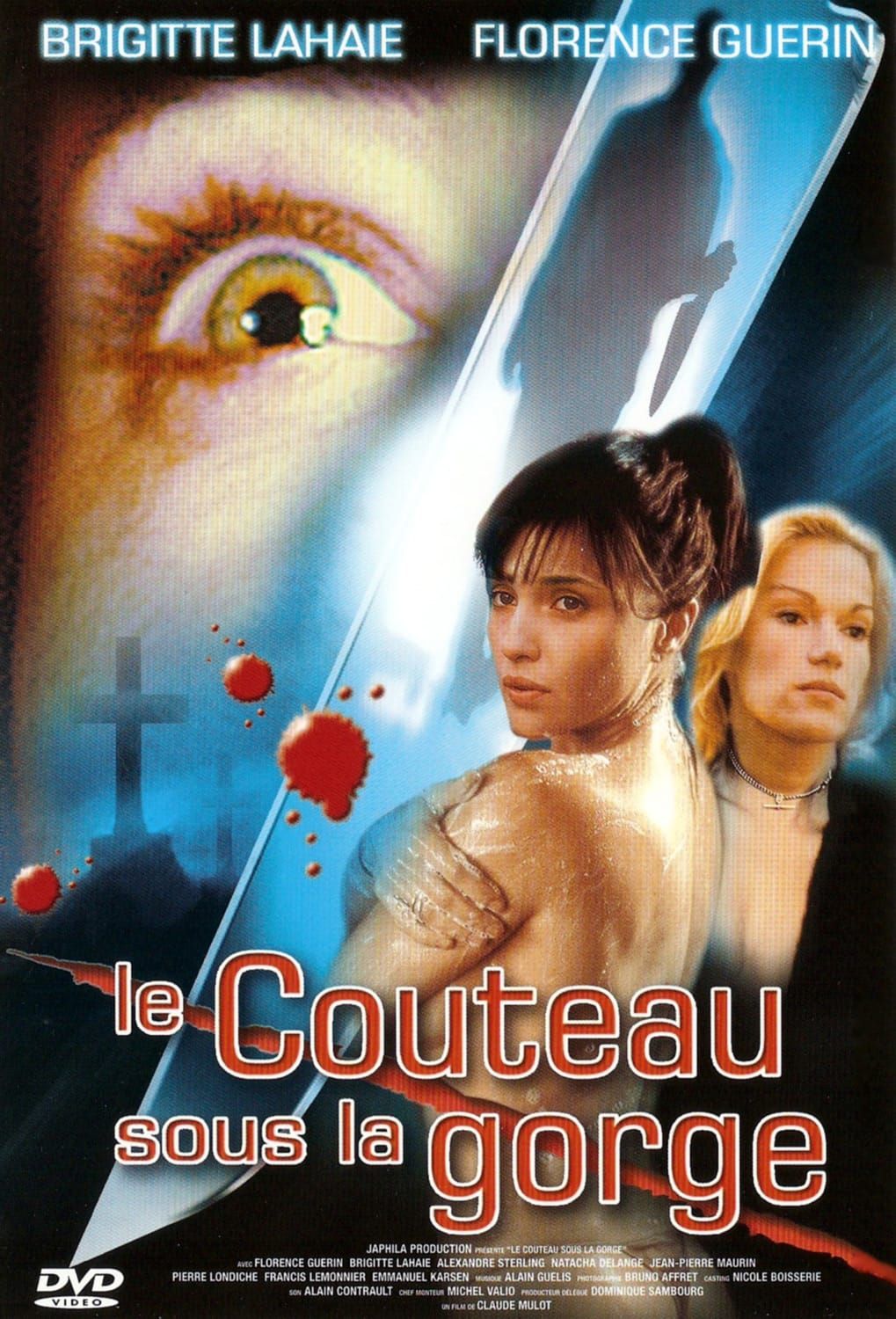
Plot: woman is stalked and assailed by deranged blade-wielding lunatic.
Le Couteau sous la gorge (or Knife Under the Throat, pour ceux qui ne parlent pas français) is perhaps not the ultimate nanar français. That illustrious distinction is held in infamy by either Norbert Georges Moutier’s mindnumbingly hypnotic gore micro-epic Ogroff (1983), Bernard Launois' strangely spellbinding gothic-slasher Devil Story (1985), or Antoine Pellissier’s seizure-inducing tour de gore Maleficia (1995). They all easily eclipsed the considerably lesser Knife Under the Throat which at least most of the time looks like an actual movie. Nevertheless, it has withstood decades of well-deserved derision and somehow has persisted the inexorable passage of time. This is a frankly styleless erotic potboiler that professes to be a thriller meant to invoke nostalgic memories of those beloved Italian gialli from old masters of the form Mario Bava, Dario Argento, or Sergio Martino. It had the swanky metropolitan locations, the prerequisite hot up-and-coming starlet looking to break into the mainstream and a starving young director who dared big even when the budget didn’t permit to. Knife Under the Throat (which, admittedly, is a semi-cool title on imagery alone) had potential but with caveat that concessions needed to be made to the producers. History has not been kind to it and perhaps deservedly so. Nobody consciously (or deliberately) sets out to make a nanar. Knife Under the Throat purports to be an erotic thriller reimagined for the then-modern day but instead lands closer to the kind of chintzy, skeezy low bilge that in the olden days used to fill the late night cable programme.
The history of writer, producer, and director Claude Mulot is mainly one of unfulfilled potential and the promise, of potential greater things marred by economic misfortune, only to end prematurely in absolute tragedy. His career trajectory bears some similarities to that with fellow Frenchman Jean Rollin and Spanish director Claudio Guerín. He was the man behind the fantastique The Blood Rose (1970) and the revolutionary blue movie Pussy Talk (1975) (a good 4 years before something similar would be done in North America). Mulot was a close friend and associate of Max Pécas. He had written Libido: the Urge to Love (1971) (with Sandra Julien) for Pécas and was known to dabble in crude sex comedies and softcore slop with things as He's Young and He Knows Everything! (1974) and Sins of the Flesh (1974) for his own oeuvre. He wrote the Cri-Cri sex comedy cycle consisting of The Teasers Go to Paris (1977), Bidasses Academy (1978), Hot Dogs On Ibiza (1979), and Who Is That Splashing in the Mediterranean? (1980) (three of which starred Alexandra Delli Colli).
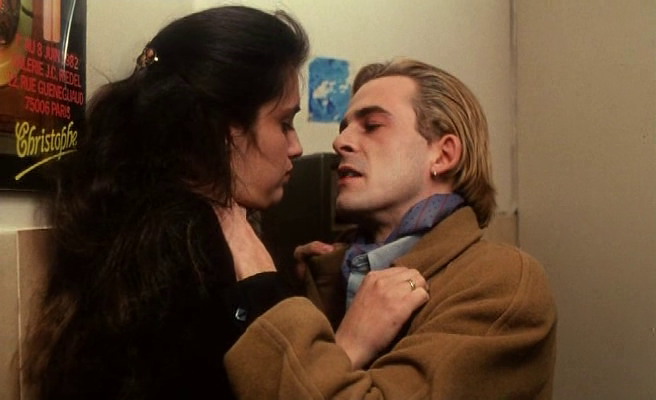
He would direct legendary rock n roller, international man of mystery, and consummate bohemien bonvivant Johnny Hallyday in The Day Breaks and the Nonsense Begins (1981) which is where is association with Japhila Productions probably began. Mulot had set to fill the niche of the better B-movie and recognition as such eluded him then as it does now. In 1976 he found himself in financial dire straits and the need to bankroll his own cinematic projects he did what Rollin had done and began, albeit reluctantly and allegedly ill at ease in the industry, to film adult features to put food on the table. To retain some of his modesty Mulot did so under the alias Frédéric Lansac. British producer Harry Alan Towers had commissioned Mulot for Black Venus (1983) which directly led Japhila Productions hiring him for this. Knife Under the Throat was supposed to be his break to the big time and route out of financial ruin. Tragically Mulot, 44, accidently drowned in Saint-Tropez while his friend Pécas was filming Let's Calm Down and Have a Cold Drink in Saint-Tropez (1987) from a script of his.
Catherine Legrand (Florence Guérin) and Florence Guerland (Natasha Delange, as Natacha Delange) are two models working for a Parisian model agency operated by Valérie Landis (Brigitte Lahaie). Landis and her bovine semi-alcoholic photographer J.B. (Jean-Pierre Maurin) specialize in controversy-courting “shocking” erotic spreads and their latest is happening at the local cemetery. Caretaker Victor (Pierre Londiche) has agreed to the production but is now having reservations. Instead of shutting the production down the morally compromised caretaker indulges in a sociopathic rampage killing a young woman who happens to look just like Catherine before throwing himself in under a truck to avoid capture, arrest, and imprisonment. When Florence and Catherine return from a business trip to the US the latter finds herself beleaguered by anonymous phone calls. These calls trigger memories of sexual assault and when she, half-naked and half-mad with terror, alleges to being followed and spied on the friendly police commissioner Durieu (Francis Lemonnier) politely dismisses her as she’s a known nymphomaniac fabulist. Durieu shrugs off her bewildering allegations as not worthy of further investigation despite the clear and present danger they pose. Even Catherine’s skeevy boyfriend Ludovic (Emmanuel Karsen) thinks she’s overreacting and is needlessly belligerent about it. The only one sympathetic to her plight is her withdrawn and reticent neighbor Nicolas Béraud (Alexandre Sterling). Is Catherine delusional or is an assailant really killing off her friends, one by one?
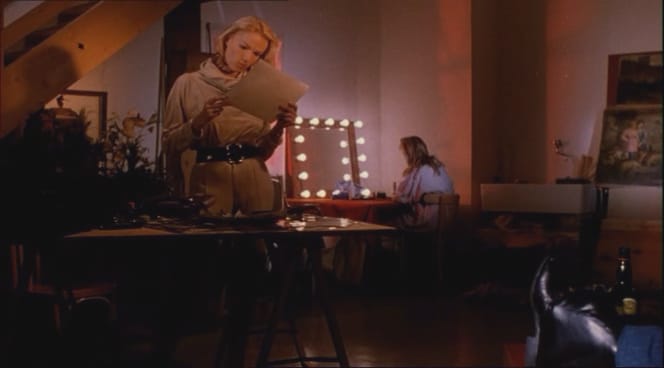
The star here is Florence Guérin or who Nanarland dubbed in an instance of utter poetry, “the French Mia Sara of the time.” While we certainly appreciate the sentiment and see the similarities if we were to make comparison it would be to Luciana Ottaviani (or Jessica Moore). Guérin mostly worked in her native France and Italy where she played roles of no real importance in a few comedies before inevitably ending up being typecast and starring in an ungodly amount of erotic potboilers, a number of frankly interchangable crime thrillers, and the occasional horror slop. It’s easy to see that Guérin had the makings of a superstar. She appeared perpetually misty-eyed, elegantly wistful, and simming with subdued sensuality best described as innocence lost and all of that poured into the delectable body of a petite goddess. La belle debuted as "woman gladiator" in Caligula and Messalina (1981) and from there she portrayed a mostly naked (and wordless) role as a featured extra in Mulot’s actually pretty solid Honoré de Balzac adaptation Black Venus (1983). Via Venus on Fire (1984) she landed her other most famous part in The Corruption (1986) earlier that year. Knife Under the Throat was the last role back at home in France before descending headfirst into some of the worst of late-stage Italian exploitation.
Among those were Mario Gariazzo's Top Model (1987) (we prefer the Joe D’Amato one from 1988), and another erotic thriller called Too Beautiful to Die (1988). In between she figured into Jesús Franco’s Faceless (1988) (also with Lahaie as well as Caroline Munro) and rounded out the 1980s with Luigi Cozzi’s barely comprehensible or coherent The Black Cat (1989). In the following decade she enlivened Alfonso Brescia’s surprisingly slick Murder in Blue Light (1991) and continued with thrillers and erotic potboilers as The Family Jewels (1991) and Stories of Seduction (1995). Her last French appearance would be in The Donor (2001). In 2009 she released the autobiographical book "C'est pas grave maman..." ("It's okay, Mom...") detailing putting back together her life while in rehabilitation after a road collision claimed the life of her five-year-old son Nicolas and the subsequent two-year-plus battle she faced in adopting her second son, Michel. Years later mademoiselle Guérin resurfaced in the dramas Heartstrings (2016), and a few years after that Beating Sun (2023), and Stella Mantoni, the Return (2025) which expanded upon a short she did in 2021. As recent as this year Florence had a small role in the historic drama Elena’s War (2026). It only took her twenty years but Flo has finally made it into the mainstream. Bien fait, miss. These days Florence (no longer sporting Guérin as a surname but Nicolas) lives in Nice and continues to model and act. More importantly, though, she is a keynote speaker at schools, associations, conferences, summits, and frequenty adresses government officials concerning the importance of road safety. She also fiercely denounces the Nicholson Law that opposes the adoption of Romanian children.
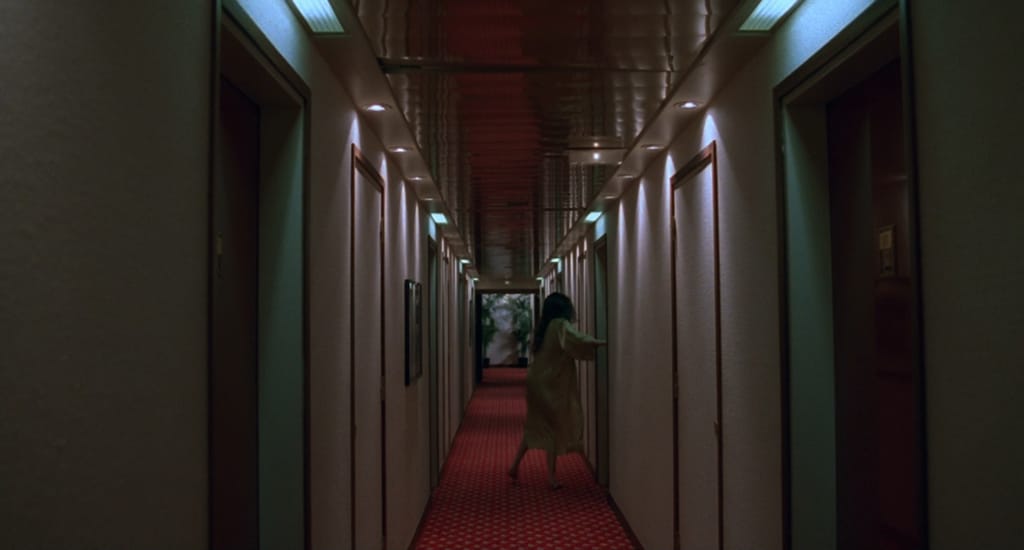
Knife Under the Throat desperately wants to be the French response to an Italian giallo murder mystery but never quite gets there. One way of viewing it is as a police procedural that’s absolutely bereft of any policing or any kind of investigation or procedures. It does have plenty of hallmarks of the subgenre: there’s the blade-wielding blackgloved, black leatherjacket-wearing killer, one specific woman is targeted, it has the incompetent police (this even has a inspector that is fainéant rather than paresseux snooping around), women primarily exist to be objectified, disrobed, and killed (usually in that order too), and there’s the eleventh hour absurd revelation in the grand finale. It’s all here and it’s all straight from the giallo playbook. If one’s feeling charitable you might say there’s some slight semblance to Abel Ferrara’s Ms .45 (1981) as Paris here is a concrete neon-drenched capitalist consumerist hellscape that’s very much a precursor to our current predicament. The city emanates a palpable sense of the blackest misanthropy and nihilism where ubiquitous moral corruption abounds, and is in the grip of deep-seated urban decay.
Walking these dirty streets are those living on the margins (or those considered undesirable) with hate in their mind feeling the scorn of the world as the degradations and deprivations of rampant poverty, systemic disenfranchisement, and lack of socio-economic mobility are callously inflicted upon them. Every man here is either a misogynist sociopath, a sexual predator, or a homicidal miscreant - and in the worst case: all three. While no woman is free from harm it predominantly befalls Guérin. Interestingly, while Guérin headlines with Brigitte Lahaie and her Catherine gets the most screentime but she hardly constitutes a real main character (and she undergoes everything almost passively at that) despite that all others orbit her sphere. Like any low budget exercise Knife Under the Throat the amateur acting is flaky with Florence Guérin and Brigitte Lahaie delivering the best performances. There’s the usual score of cheap blaring synths, imitation strings, and overly loud electronic percussion and piano. It always mistakes generous and often gratuitous nudity as sensual or erotic (which it never is). At a brisk 85 minutes it’s brutally efficient and not in the least cheapened by an open ending baiting a sequel that, thankfully, never materialized.
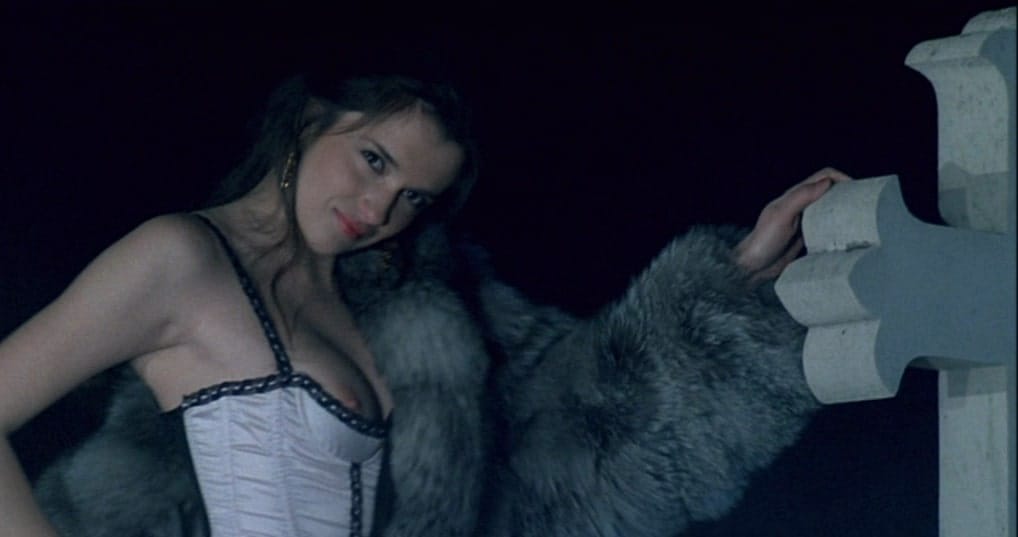
How wise was it to release something like this amidst the ongoing deluge of American slashers (that had been going for a good five years at that point) and their imitations around the world? That remains open for debate. The matter-of-fact title alone should appeal to bloodthirsty audiences that ate up grindhouse grue as Three on a Meathook (1972), The Centerfold Girls (1974), The Toolbox Murders (1978), The Driller Killer (1979), and The Prowler (1981). In our humblest of opinions Knife Under the Throat is due reevaluation and could, and perhaps should, be considered as a spiritual successor to Max Pécas’ Love and Fear (1967) from almost twenty years before. In spirit and feel it’s closest to Lucio Fulcio’s mildly insane The New York Ripper (1982) than anything else and it’s not nearly as subtle or quietly sophisticated as either Fright (1971) or Maniac (1980).
If you’re looking for roughly the same thing Mario Bava’s Blood and Black Lace (1964) and México’s Terror and Black Lace (1985) are the obvious and better choices. At worst Mulot opened the proverbial floodgates for contemporary sleazy thriller degeneracy as Our Last Weekend (2011); Good Night, Said Miss Bird (2012), Lucero (2019), Killing Time (2022), and She Only Eats Meat (2026) from Norberto Ramos del Val and César del Álamo on your preferred streaming service. Apropos of nothing, this was released the same year as Exploits Of a Young Don Juan (1986) and the two-part period drama Jean de Florette (1986) and Manon des Sources (1986). The innately dour reputation of Knife Under the Throat does precede it as it is historic for all the right reasons and infamous for all the wrong ones.